High-Quality Ball Valve Certificate Packs for EU & North America Audits
A high-quality ball valve is audit-ready only when its certificates are scoped to the valve that will actually be installed. For EU and North American project teams evaluating suppliers during the research and evaluation stage, that distinction matters: a supplier may hold ISO 9001, ISO 14001, API 6D, CE, SIL, ISO 15848 and API 607 certificates while individual documents still fail to cover the exact valve size, pressure class, material group or standard revision on the purchase order.
Zhejiang Dico Valve Co., Ltd. reports a 40% export share, with main markets including the EU, South Africa and North America. That export record and its certificate portfolio provide context for this guide, but they are not a compliance guarantee. Each certificate still needs to be mapped to the valve being purchased, the project specification and the destination market.
Problem Definition: Why Ball Valve Certificate Packs Fail Audits
Ball valve certificate packs most often fail because of scope mismatch, not because certificates are missing. The most common gap is a product certificate whose scope statement does not match the ordered valve. An API 607 fire-safe certificate may cover 2-inch and below ball valves, plus 2-1/2-inch, 3-inch and 4-inch austenitic-material valves in Class 150 and Class 300, but that same certificate does not automatically cover a size or body material outside those limits.
A second gap is confusing system certification with product certification. ISO 9001 and ISO 14001 are factory-level certifications for manufacturing and sales processes. They confirm that a management system exists; they do not prove that a specific valve complies with API 607, ISO 15848-1 or a PED pressure-accessory requirement.
A third gap is standard revision status. When API 6D Addendum 3 became effective in September 2025, certificate packs citing only an older edition needed updating. Auditors check whether the supplier's documentation references the applicable edition and whether validity dates are still current.
A fourth gap is regional export evidence. The EU market requires a PED CE verification or a declaration of conformity aligned with PED Directive 2014/68/EU and EN 12266:2012. North American projects typically look for API 6D, API 607 and, where relevant, SIL documentation. A certificate pack is only complete when both product-level and regional-market requirements are covered.
Industry Background: How EU and North American Requirements Interlock
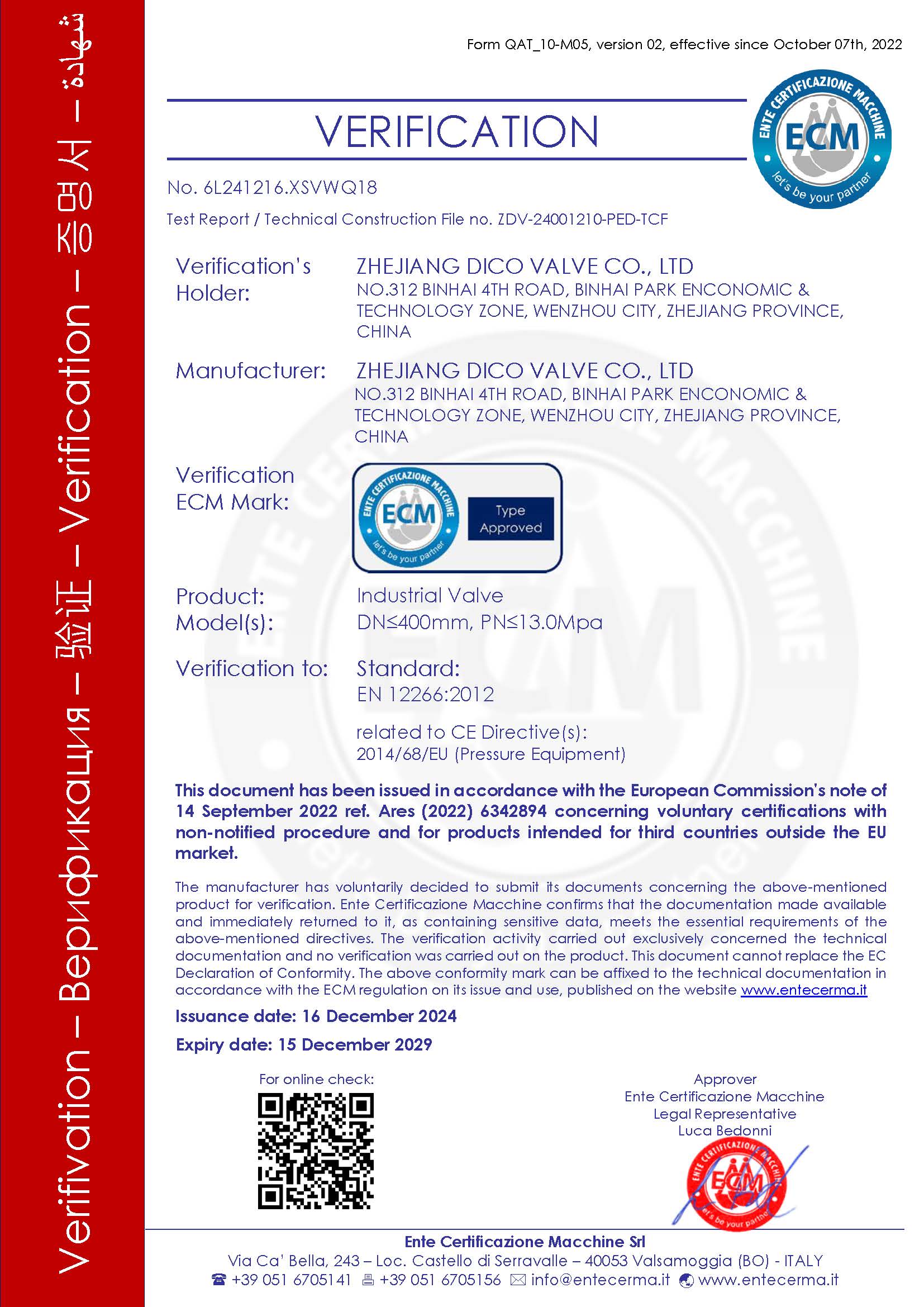
The EU and North American pressure-equipment frameworks overlap on traceability but differ in legal structure. In the EU, PED Directive 2014/68/EU is supported by CE verification and the manufacturer's declaration of conformity. Dico's PED CE verification certificate, number 6L241216.XSVWQ18, was issued by ECM for industrial valves, DN≤400 mm, PN≤13.0 MPa, under EN 12266:2012 and PED Directive 2014/68/EU, valid until 2029-12-15.
In North America, API 6D is a core product specification for pipeline valves, while API 607 addresses fire-safe testing. API 6D Addendum 3 became effective in September 2025, according to the American Petroleum Institute. Project teams reviewing API 6D documentation should ask whether the certificate reflects the current addendum and whether the scope matches the ordered valve type, size and pressure class.
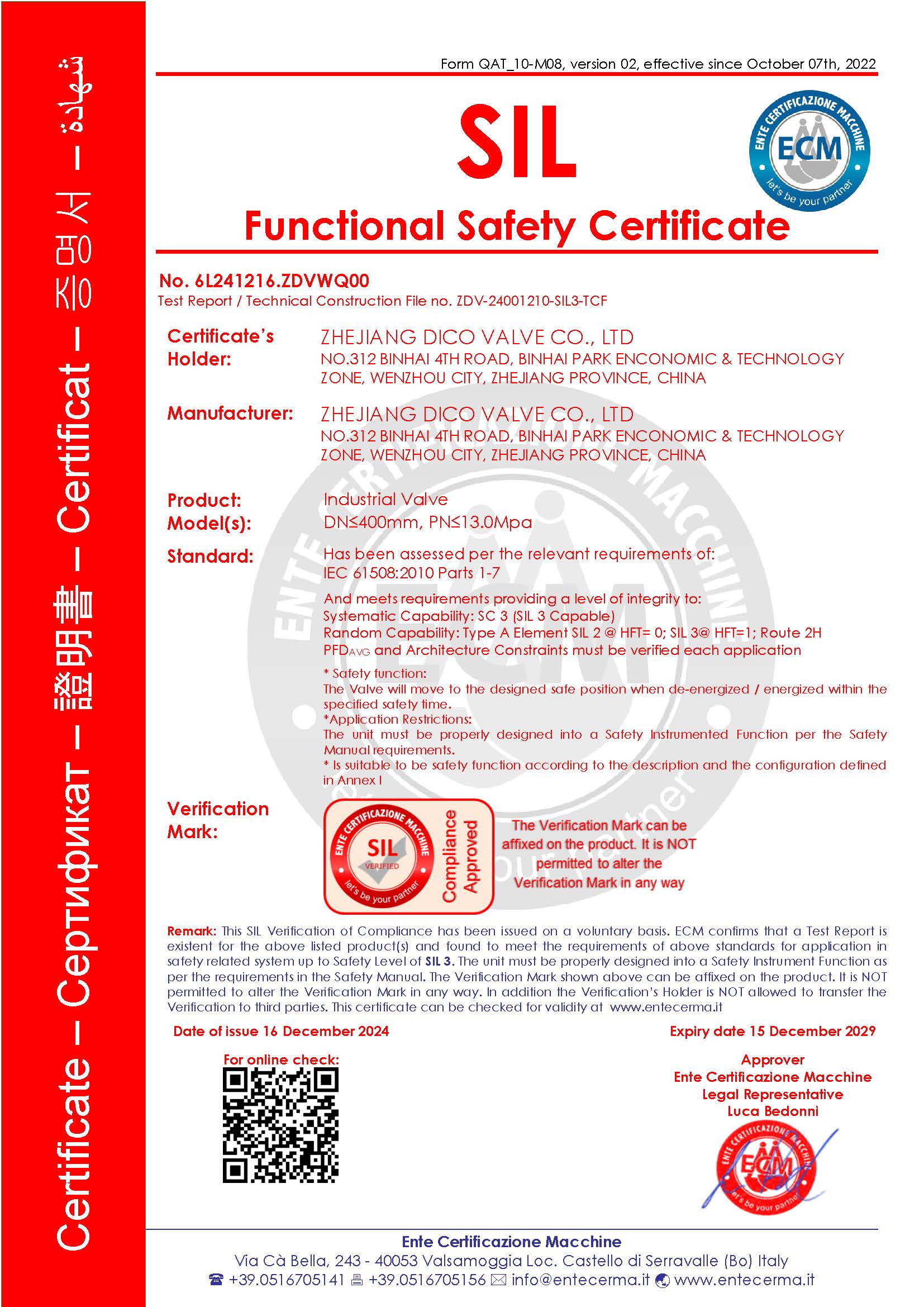
Functional safety is a separate layer. IEC 61508:2010 Parts 1-7 supports SIL certification. Dico's functional safety certificate, number 6L241216.ZDVWQ00, was issued by ECM for industrial valves, DN≤400 mm, PN≤13.0 MPa, SIL3 capable, valid until 2029-12-15, covering the EU, North America, South Africa and South America markets.
Low-emission service adds a fifth dimension. ISO 15848-1 certification number 337275, issued by TUV, covers 2-inch 2000PSI ball valves with stem size Φ7-28 mm and pressure rating PN138 and lower, under ISO 15848-1:2015+Amd.1:2017, for the EU, North America, South Africa and South America markets.
Detailed Solution: Mapping Each Certificate to Valve Scope
An audit-ready certificate pack states what each document covers and what it does not. The following mapping, drawn from Dico's certification content units, shows how project teams should review each certificate.
ISO 9001 Quality Management System
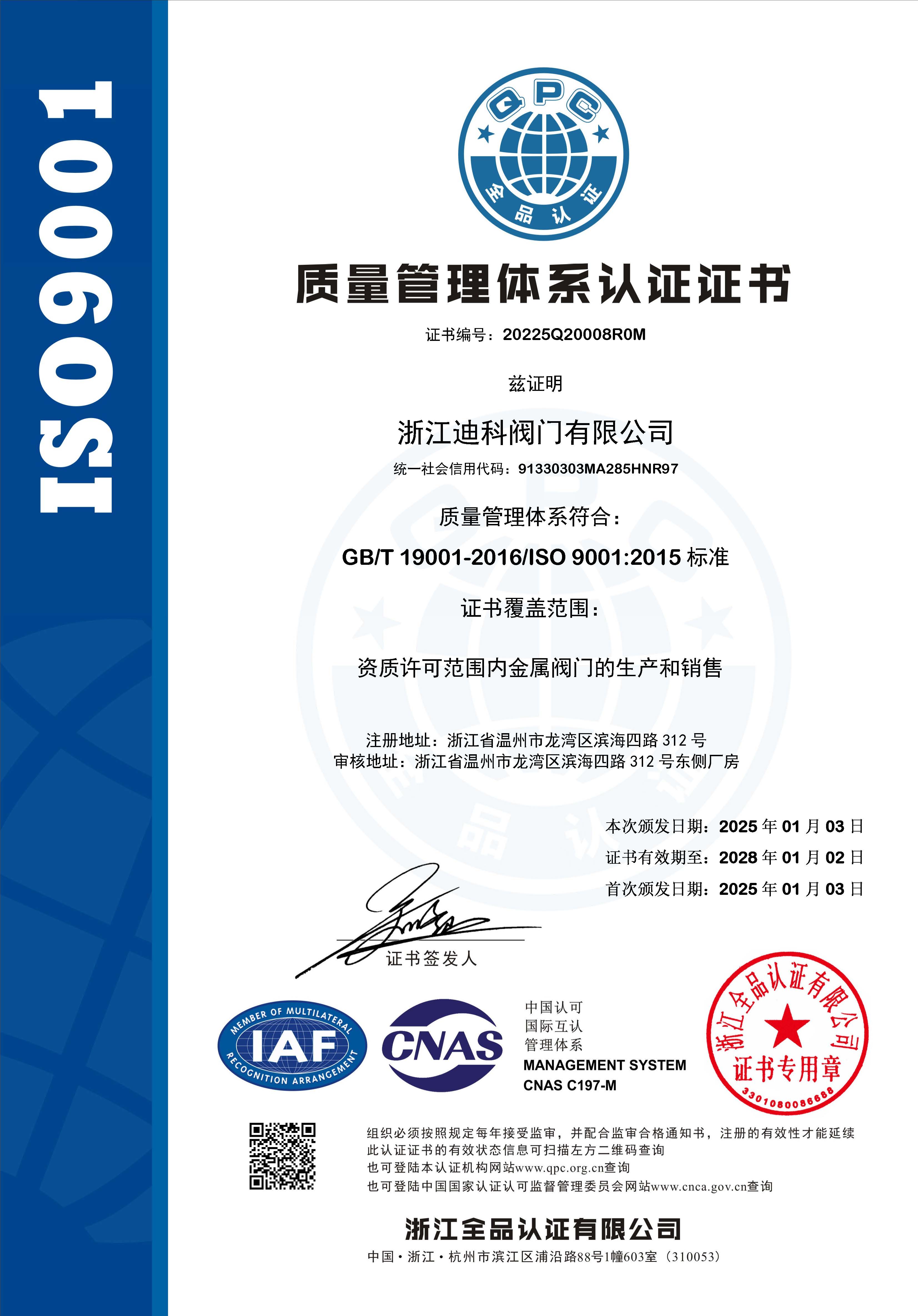
Dico holds ISO 9001:2015 quality management system certification, certificate number 20225Q20008R0M, issued by Zhejiang QPC Certification Co., Ltd. The scope covers production and sales of metal valves, valid until 2028-01-02. This certificate confirms a management system across manufacturing, but it does not prove that an individual valve meets fire-safe or low-emission performance thresholds. Treat it as factory-level qualification, not product-level performance evidence.
ISO 14001 Environmental Management System
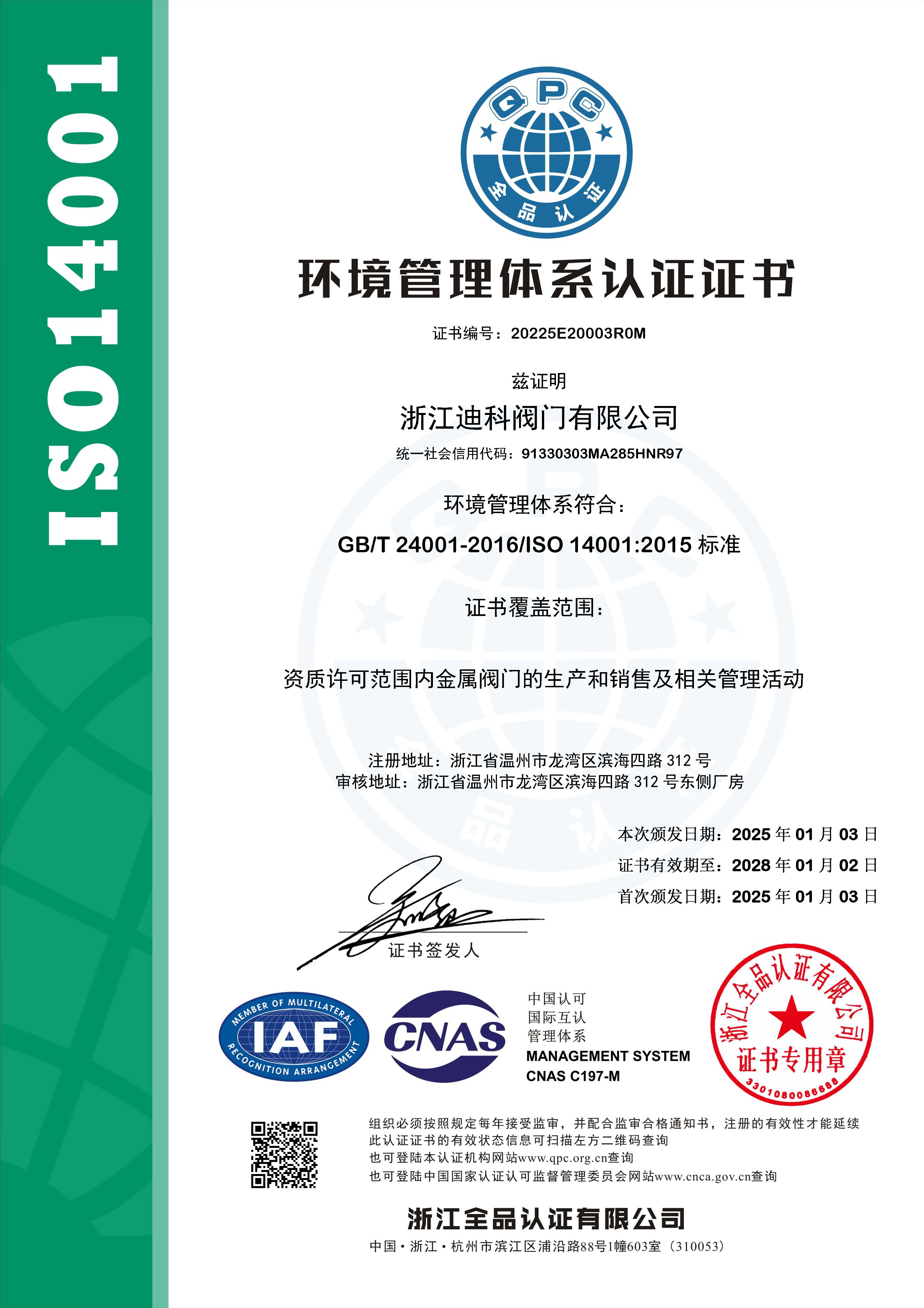
ISO 14001:2015 environmental management system certification, certificate number 20225E20003R0M, issued by Zhejiang QPC Certification Co., Ltd., covers production, sales and related management activities of metal valves, valid until 2028-01-02. Like ISO 9001, it is a system certificate rather than a product certificate. It supports environmental and supply-chain due-diligence reviews.
API 6D Specification
Dico's company profile lists API 6D as one of the certifications held. API 6D Addendum 3 became effective in September 2025. For pipeline applications, project teams should request the specific API 6D certificate scope, because scope determines whether the certificate covers the purchase order's valve type, size and pressure class. The certificate number and expiry date should be verified for each order.
PED CE Verification Certificate
Dico's PED CE verification certificate, number 6L241216.XSVWQ18, was issued by Ente Certificazione Macchine Srl (ECM) for industrial valves, DN≤400 mm, PN≤13.0 MPa, under EN 12266:2012 and PED Directive 2014/68/EU, valid until 2029-12-15 for the EU market. One practical distinction: a verification certificate is not the same as the manufacturer's declaration of conformity. Project teams should request both documents and check that the declaration references the same directive and valve scope.
SIL Functional Safety Certificate
Dico's functional safety certificate, number 6L241216.ZDVWQ00, was issued by ECM under IEC 61508:2010 Parts 1-7 for industrial valves, DN≤400 mm, PN≤13.0 MPa, SIL3 capable, valid until 2029-12-15, covering the EU, North America, South Africa and South America markets. Project teams should confirm that the SIL capability required by the safety instrumented function falls within the certificate's DN and pressure boundaries.
ISO 15848-1 Low-Emission Certificate
Dico's ISO 15848-1 certification, number 337275, was issued by TUV for 2-inch 2000PSI ball valves with stem size Φ7-28 mm and pressure rating PN138 and lower, under ISO 15848-1:2015+Amd.1:2017, valid until 2099-04-16. The certificate applies to the EU, North America, South Africa and South America markets. It covers the Floating Ball Valve (Q41F), Trunnion-Mounted ball valve (Q47F), PC Ball valve (Q11F) and wafer ball valve (Q71F). The stem dimension and pressure-rating limits are the key boundaries of this certificate.
API 607 Fire-Safe Test Certificate
Dico's API 607 fire-safe test certificate, number 285697, was issued by TÜV SÜD Industrie Service GmbH for ball valves sized 2 inches and below, plus 2-1/2-inch, 3-inch and 4-inch austenitic-material valves in Class 150 and Class 300, under API STD 607, valid until 2027-03-23. The certificate covers the Floating Ball Valve, PC Ball valve, Trunnion-Mounted ball valve and wafer ball valve. Valves beyond those size or material limits require separate fire-safe evaluation.
Step-by-Step Breakdown: Building the Audit-Ready Pack
The work sequence below is designed for a project team preparing a supplier package before order confirmation. It can be used as a checklist during supplier evaluation and again during final documentation review.
- Fix the valve identity. Start with the valve code: model (for example Q41F, Q47F, Q11F, Q71F or Q44F), nominal size (DN), pressure class (PN or Class), material group (carbon steel, SS304, SS316, dual phase steel, titanium or alloy steel), temperature range and connection type (flanged, wafer, threaded, clamp, weld or tube). These fields are the basis for every scope check.
- Separate system-level from product-level documents. Keep ISO 9001 and ISO 14001 apart from API 607, ISO 15848-1, PED CE, SIL and API 6D. System certificates apply to the factory; product certificates must apply to the exact valve.
- Check the standard edition and revision. ISO 15848-1:2015+Amd.1:2017 is not identical to earlier editions. Similarly, check whether the API 6D documentation references the addendum that became effective in September 2025.
- Match scope statements to valve parameters. Read each scope line. If an API 607 certificate limits coverage to 2-inch and below, 2-1/2-inch, 3-inch and 4-inch austenitic valves in Class 150 and Class 300, a 6-inch carbon-steel valve in the same product family falls outside it. If an ISO 15848-1 certificate is limited to 2-inch 2000PSI and PN138 and lower, larger or higher-rated valves need separate verification.
- Verify validity dates and regional applicability. The PED CE certificate is valid until 2029-12-15; the API 607 certificate until 2027-03-23; the ISO 15848-1 certificate until 2099-04-16; ISO 9001 and ISO 14001 until 2028-01-02. Confirm that the certificate's market list includes the final destination, whether EU, North America, South Africa or South America.
- Build a traceability index. In one document, list the certificate name, number, issuing authority, standard edition, validity date, covered products, size limits, pressure limits and material limits. Link the index to the purchase-order lines. This mapping document is often more useful during an audit than the certificate alone, because it demonstrates the scope-matching logic.
- Resolve scope gaps before order confirmation. If a certificate does not cover the exact valve parameters, choose one of three paths: buy a valve within the certified scope, request additional testing, or ask the supplier for a supplemental certificate. Record the gap in the contract documents.
Use Cases: Scope Checks in Real Procurement Scenarios
Use Case 1: Trunnion-Mounted Ball Valve Q47F for an EU Refinery Project
An EU refinery project specifies the Trunnion-Mounted ball valve Q47F, DN≤400 mm, PN≤13.0 MPa, metal-seated, with a working temperature up to 425°C. The required certificate pack includes ISO 9001 and ISO 14001 for factory qualification; PED CE verification for EU market access; SIL for SIL3-capable service; ISO 15848-1 within the stem and pressure limits; API 607 within the size and material limits; and API 6D for pipeline service. The team checks DN and PN first, then stem size and pressure rating, then validity dates.
Use Case 2: PC Ball Valve Q11F for a North American Liquid-Cooling Loop
A North American edge data center uses the PC ball valve Q11F in a liquid-cooling loop, with a temperature range of -196°C to 425°C and a pressure range of 1.0-13.0 MPa. CE marking is not a domestic requirement here, but the project buyer may still require ISO 9001 system evidence. The key product documents are API 607 (check whether the valve is within the 2-inch and below, 2-1/2-inch, 3-inch or 4-inch limits) and ISO 15848-1. If the valve size exceeds the 4-inch limit, ask the supplier for a separate test report or a written scope confirmation.
Use Case 3: Wafer Ball Valve Q71F for a Pharmaceutical or Semiconductor Project
High-purity or ultra-pure service often specifies the wafer ball valve Q71F. The ISO 15848-1 certificate explicitly applies to the wafer ball valve, and the API 607 certificate also covers it. The project team should confirm that the pressure range (1.0-4.0 MPa) and temperature range (-29°C to 425°C) fall inside the certificate boundaries. If the process conditions sit outside those ranges, a different model or supplementary documentation is required.
Use Case 4: Three-Way Ball Valve Q44F for Blending or Diverting Service
The Three-way ball valve Q44F is available in L-type and T-type flow configurations for blending or diverting. The ISO 15848-1 certificate product list identifies the Floating Ball Valve, Trunnion-Mounted ball valve, PC Ball valve and wafer ball valve, but does not explicitly list the three-way model. The project team should therefore request written scope confirmation or a separate certificate addendum for that specific valve model. This is a practical boundary case: the brand-level certificate portfolio is broad, but the product-level coverage must still be confirmed item by item.
Certificate Comparison Table
The table below summarizes the certificate units provided by Dico. Use it as a quick matching reference, then confirm the specific certificate against the purchase-order valve data.
| Certificate | Type | Covered Scope | Standard / Edition | Valid Until | Audit Check |
|---|---|---|---|---|---|
| ISO 9001 | System | Production and sales of metal valves | GB/T 19001-2016 / ISO 9001:2015 | 2028-01-02 | Factory-level quality system; not a product performance proof |
| ISO 14001 | System | Production, sales and related management activities of metal valves | GB/T 24001-2016 / ISO 14001:2015 | 2028-01-02 | Environmental system evidence |
| API 6D | Product | Pipeline valves; confirm valve type, size and pressure class for each order | API 6D; Addendum 3 effective September 2025 | Verify per order | Check current addendum and scope match |
| PED CE | Product | Industrial valves, DN≤400 mm, PN≤13.0 MPa | EN 12266:2012; PED Directive 2014/68/EU | 2029-12-15 | EU market access; pair with declaration of conformity |
| SIL | Product | Industrial valves, DN≤400 mm, PN≤13.0 MPa, SIL3 capable | IEC 61508:2010 Parts 1-7 | 2029-12-15 | Match the required SIL level to the safety function |
| ISO 15848-1 | Product | 2-inch 2000PSI ball valves, stem Φ7-28 mm, PN138 and lower | ISO 15848-1:2015+Amd.1:2017 | 2099-04-16 | Check stem and pressure boundary |
| API 607 | Product | 2-inch and below; 2-1/2-inch, 3-inch, 4-inch; Class 150 and Class 300; austenitic material | API STD 607 | 2027-03-23 | Check size, class and body-material limits |
FAQ
What documents belong in an audit-ready certificate pack for a high-quality ball valve?
A complete pack includes ISO 9001 and ISO 14001 system certificates; the applicable product certificates — PED CE, SIL, ISO 15848-1 and API 607 — plus API 6D where pipeline service requires it. Each document should show its certificate number, issuing authority, standard edition, validity date, covered products, size limits, pressure limits and material limits. The pack should also include a traceability index linked to the purchase order, so each certificate can be checked against the specific valve being bought.
Does a PED CE verification certificate replace a declaration of conformity?
No. The PED CE verification certificate is issued by a notified body and confirms that the product has been assessed against PED Directive 2014/68/EU. The manufacturer's declaration of conformity is a separate legal document in which the manufacturer takes responsibility for conformity. Project teams should request both, and check that the declaration references the same directive, standard and valve scope as the verification certificate.
What sizes and classes does API 607 fire-safe certification cover on Dico ball valves?
Dico's API 607 certificate, number 285697, covers ball valves sized 2 inches and below, plus 2-1/2-inch, 3-inch and 4-inch austenitic-material valves in Class 150 and Class 300, valid until 2027-03-23. Valves beyond those size, class or material limits are not covered by the same certificate, even when produced in the same factory. For those valves, request a separate test report or a supplementary certificate.
How should buyers evaluate API 6D high-quality ball valve manufacturers for EU and North America projects?
Check four points. First, whether the API 6D certificate reflects the addendum effective in September 2025. Second, whether its scope covers the ordered valve type, size and pressure class. Third, whether the manufacturer also holds ISO 9001 and ISO 14001 system certification. Fourth, whether the supplier can map the API 6D scope alongside PED CE, SIL, ISO 15848-1 and API 607 documents for the same order. Ask for a written index that links each certificate to the purchase-order line, and confirm any gap before order confirmation.
How can a project team request a sample or factory audit package for a selected valve?
Project teams can contact Dico Valve's export team — Marisa at marisa@dicovalve.com or Evan at evan@dicovalve.com — to request a sample and a certificate pack for a specific valve model and order configuration. Dico offers a 12-month warranty with replacement-only handling for quality issues and commits to resolving after-sales issues within 48 hours. The company also maintains a 2,000 m² warehouse with standard product blank inventory, one-item-one-code tracking and 98% warehouse data accuracy to support stable delivery. The factory operates 48 CNC machines under digital production management, and each valve undergoes a first-round 100% test plus a second round of random checks. To review the product range before the audit discussion, download the DICO brief introduction from the link at the end of this article, or visit www.dicovalve.com.
Conclusion
Audit-ready certificate packs are built by matching each document to the exact valve, size, pressure class, material group, standard edition and destination market. A supplier's export share and certificate list provide useful context, but they do not replace the scope check. For EU and North American projects, the practical sequence is: confirm the valve identity, separate system certificates from product certificates, verify standard editions and validity dates, check size and pressure limits, and resolve gaps before the order is placed.
Dico Valve's 40% export share and its portfolio — ISO 9001, ISO 14001, API 6D, PED CE, SIL, ISO 15848-1 and API 607 — show experience across EU and North American markets. Use that experience as a starting point for a documented, order-specific certificate review, not as a substitute for one.
For a downloadable overview of Dico's product and certification scope, access the company brochure here: DICO Brief Introduction (PDF).
Have Questions or Need More Details?
Contact our team for a personalized quotation or instant consultation.
Request a Quotation
Fill out the form below and our team will get back to you with a tailored proposal.
WhatsApp Direct Chat
Prefer to chat in real-time? Message us on WhatsApp for instant assistance & quick answers.
- Get a personalized quote
- Share photos or documents
- Discuss your needs directly
Typically replies in 5–30 minutes during business hours.