
Trunnion-Mounted Ball Valve Technical Guide: Materials, Pressure, Temperature, and Seal Selection
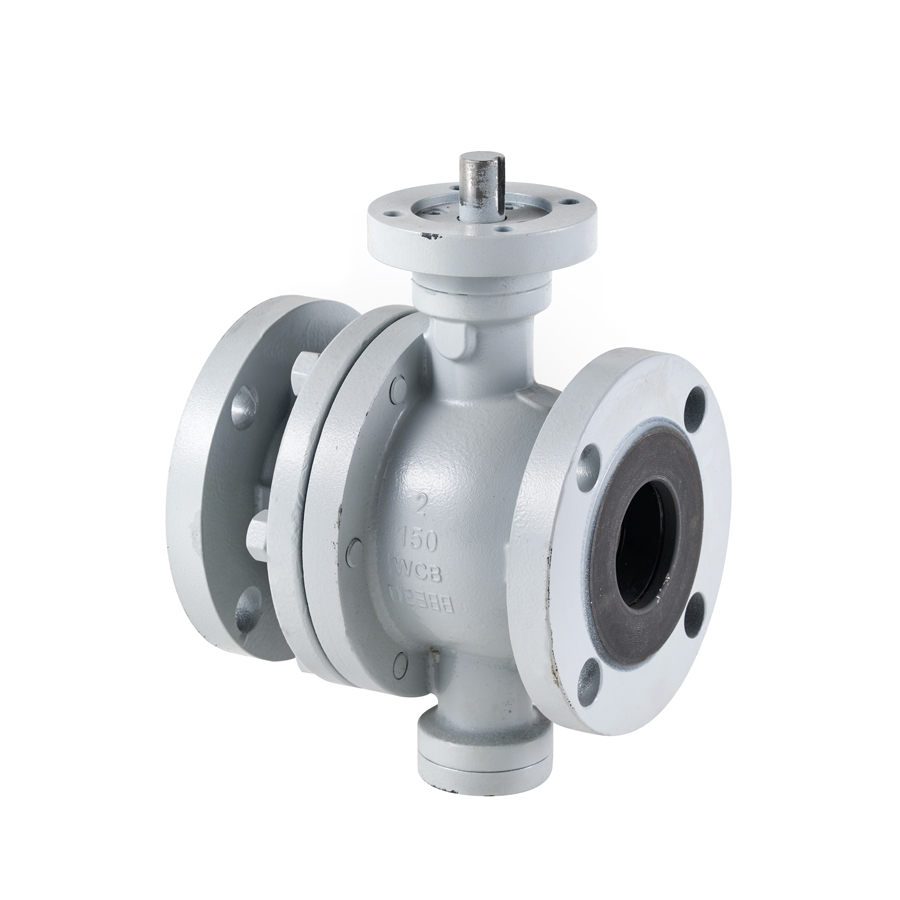
Dico Q47F trunnion-mounted ball valve — flanged body with a machined flange outer circle, ISO 5211 mounting pad, and a trunnion-supported ball for stable seat loading.
Choosing a trunnion-mounted ball valve rarely fails at the level of “which type”. It fails at the level of parameters. Two valves can both be listed as flanged quarter-turn units rated 1.0–10.0 MPa and still behave completely differently once the medium is hot steam, the line is not perfectly clean, or the actuator has to deliver repeatable torque after years of cycling.
The Dico Q47F trunnion-mounted ball valve is a flanged ball valve available in both soft-seated and metal-seated configurations. It is rated from 1.0 to 10.0 MPa and from -29 °C to 425 °C, and can be supplied in carbon steel, SS304, SS316, dual phase steel, titanium or alloy steel, with PTFE, PPL, PI, PEEK or Stellite seats and either a hollow or a solid ball. Zhejiang Dico Valve Co., Ltd., founded in 2015 in Wenzhou, Zhejiang, manufactures this series as part of its high-end ball valve range. This guide works through the four parameters that decide whether such a valve actually fits — material, pressure, temperature and seal — and explains what the associated API STD 607, ISO 15848-1 and PED CE documentation covers.
Problem Definition: Why a Pressure and Temperature Line Is Not a Selection
The most common specification error is treating a headline envelope as if it were a single material's rating. The -29 °C to 425 °C range of the Q47F describes what the assembly can be built to cover across its material and seat combinations; it does not mean one seat material works across that entire span. In Dico's published seat data, PEEK is stated with an upper working limit of 260 °C, and PTFE creep is described as accelerating above 200 °C. A buyer who selects a valve by the envelope and then accepts a soft seat by default is very likely to end up over temperature.
A second gap is certificate scope. A fire-safe certificate number answers a compliance question only when it is read together with its size, class and material scope. Dico's API STD 607 fire-safe certificate, number 285697, is scoped to ball valves in 2'' and below, 2-1/2'', 3'' and 4'', in Class 150 and Class 300, in austenitic material.
The third gap is interface detail. Flange construction, ISO 5211 mounting pad availability and anti-static construction are often treated as commercial extras. In practice they determine whether the valve can be actuated, grounded and installed as the project intended.
Industry Background: A Specification-Driven Segment Inside a Growing Market
The global ball valve market was estimated at USD 12.6 billion in 2025 and is projected to reach USD 22.8 billion by 2035, according to Global Market Insights. Within that market, floating ball valves held a 61.8% share in 2025 according to Straits Research, which means trunnion-mounted and other heavy-duty configurations sit in the more specification-sensitive part of the category, where selection is driven by pressure class, bore size and documentation rather than by unit count. Published market size estimates vary between research houses: Straits Research estimates the 2025 market at USD 14.8 billion against the Global Market Insights figure of USD 12.6 billion, a difference attributed to sub-segment coverage, so single-source numbers should be treated as directional.
Two adjacent trends push in the same direction. Data center liquid cooling valves were projected to grow from USD 0.27 billion in 2025 to USD 1.80 billion by 2032 (MarketsandMarkets), and stainless steel 316L/304 accounted for a 68% share of valves in the pharmaceutical market in 2025 (Market Research Insights). Both segments reward documented material grades, traceable heat numbers and leak-tightness evidence. On the standards side, API 6D Specification Addendum 3 became effective in September 2025, which means pipeline valve buyers should check which edition and addendum a supplier's documentation actually references.
Detailed Selection Parameters for the Dico Q47F Trunnion-Mounted Ball Valve
1. Body and Ball Material Selection
The Q47F can be built in carbon steel, SS304, SS316, dual phase steel, titanium or alloy steel. The material decision should follow the medium first and the mechanical duty second:
- Carbon steel — the economic choice where the medium is not aggressive, such as treated water and general utility service.
- SS304 and SS316 — the standard corrosion-resistant and hygienic grades, widely used in pharmaceutical, water treatment and general chemical service.
- Dual phase steel — generally selected where higher strength and improved resistance to chloride-related stress corrosion are both required.
- Titanium — for aggressive chloride-bearing and oxidizing media where stainless grades are not adequate.
- Alloy steel — where elevated-temperature strength governs the design.
Two construction details carry as much weight as the grade itself. The ball can be supplied in hollow or solid form, and Dico sources balls from a high-end supplier with heat number traceability, so the ball material can be traced back to a heat record. Ball geometry is finished by high-precision spherical polishing, and the seats are precision-machined with a smooth surface, which is what sealing performance ultimately depends on. The body of this series is built heavier than the manual series and follows a thick flange standard, with the flange outer circle machined.
2. Pressure Range and What It Does Not Tell You
The Q47F is rated from 1.0 to 10.0 MPa. Across the Dico range the pressure envelope varies by body style: the PC ball valve (Q11F) is rated 1.0–13.0 MPa, the floating ball valve (Q41F) 1.0–10.0 MPa, and the wafer ball valve (Q71F) 1.0–4.0 MPa. The governing certification scope is stated as industrial valves DN ≤ 400 mm and PN ≤ 13.0 MPa for both the PED CE verification certificate and the functional safety certificate.
A pressure rating is not a differential-pressure guarantee at every size. In Dico's published seat guidance, pure PTFE is described as experiencing severe cold flow under high pressure, and for large-diameter, high-differential applications the opening and closing torque must be assessed, with a fixed-sphere structure selected if necessary. That is precisely the case the trunnion-mounted design exists to serve.
3. Temperature Range and the Upper Limit That Actually Matters
The Q47F envelope is -29 °C to 425 °C. Because the ceiling is set by the seat rather than by the shell, the practical question is not whether the valve can be built to 425 °C, but which seat configuration keeps it inside its documented range. Within the published seat data:
- PTFE is machined (Daikin PTFE with machining is used), and creep is described as accelerating above 200 °C.
- PEEK is stated with an upper working limit of 260 °C.
- Stellite is the metal-seated option in the series, used where soft seats fall outside their range.
For a 425 °C design point, the selection therefore lands on a metal-seated, Stellite-equipped build with a body material chosen for elevated-temperature strength, not on a soft-seated default. Maximum operating temperature, not nominal line temperature, should drive that decision, with temperature rise and thermal shock taken into account.
4. Seat and Seal Material Selection
Seat selection is the parameter most often decided by habit. Dico's published decision logic is sequential rather than single-factor: temperature, medium, pressure and corrosion are applied in order, gradually narrowing the options. The soft-seated criteria are explicit:
- Clean media requiring zero leakage, typically Class VI.
- Operating temperature of 260 °C or below, the PEEK upper limit.
- Medium-to-low pressure conditions, stated as Class ≤ 1500.
- Frequent opening and closing where low operating torque matters.
- Highly corrosive media, where PTFE or FKM is appropriate.
The same guidance flags the failure modes to check before committing: particles are described as a “killer” of soft seals and even small amounts accelerate wear, while fibrous media also require hard seals; glass-fiber PTFE is not resistant to HF or strong alkalis; and rubber-type selections must be confirmed against chemical compatibility tables rather than experience.
| Seat material | What the published data states | Selection note |
|---|---|---|
| PTFE | Daikin PTFE with machining; creep accelerates above 200 °C | Default choice for clean media and tight shut-off at moderate temperature |
| PPL | Listed Q47F seat option | Confirm the actual temperature and medium against the application before release |
| PI | Listed Q47F seat option | Confirm the actual temperature and medium against the application before release |
| PEEK | Listed with an upper working limit of 260 °C | Highest-temperature soft-seat option in the published data |
| Stellite | Metal-seated option in the Q47F and Q41F series | Used where soft seats fall outside temperature, cleanliness or pressure criteria |
Seat options on the Dico Q47F trunnion-mounted ball valve, based on published Dico seat data.
5. Connection, ISO 5211 Mounting Pad and Anti-Static Construction
The Q47F uses a flanged connection with a machined flange outer circle and a thick flange standard. An ISO 5211 mounting pad is provided for direct actuator mounting, which is what allows the same valve body to be supplied as a pneumatic or electric ball valve without an adapter plate. The series also includes an anti-static structure for electrical continuity through the valve, and three-layer sealing of the valve stem — the stem sealing that the ISO 15848-1 qualification addresses.
6. Certification Scope: What Each Certificate Actually Covers
For constraint-driven buying, the scope line is the substance of the certificate.
| Certificate | Number | Issued by | Stated scope | Validity |
|---|---|---|---|---|
| API STD 607 Fire-safe Test Certificate | 285697 | TÜV SÜD Industrie Service GmbH | Ball valves, size 2'' and below; 2-1/2'', 3'', 4''; Class 150, Class 300; austenitic material | 24 Mar 2022 – 23 Mar 2027 |
| ISO 15848-1 Qualification Certificate | 337275 | TUV | 2'' 2000 PSI ball valve; stem size Φ7–28 mm; pressure rating PN138 and lower | 16 Apr 2026 – 16 Apr 2099 |
| PED CE Verification Certificate | 6L241216.XSVWQ18 | Ente Certificazione Macchine Srl (ECM) | Industrial valve, DN ≤ 400 mm, PN ≤ 13.0 MPa; EN 12266:2012 / PED Directive 2014/68/EU | 16 Dec 2024 – 15 Dec 2029 |
| Functional Safety Certificate (SIL) | 6L241216.ZDVWQ00 | ECM | Industrial valve, DN ≤ 400 mm, PN ≤ 13.0 MPa, SIL3 capable; IEC 61508:2010 Parts 1–7 | 16 Dec 2024 – 15 Dec 2029 |
| ISO 9001:2015 Quality Management System | 20225Q20008R0M | Zhejiang QPC Certification Co., Ltd. | Production and sales of metal valves | 3 Jan 2025 – 2 Jan 2028 |
| ISO 14001:2015 Environmental Management System | 20225E20003R0M | Zhejiang QPC Certification Co., Ltd. | Production, sales and related management activities of metal valves | 3 Jan 2025 – 2 Jan 2028 |
| ISO 45001:2018 Occupational Health and Safety | 20225S20004R0M | Zhejiang QPC Certification Co., Ltd. | Production, sales and related management activities of metal valves | 3 Jan 2025 – 2 Jan 2028 |
Certification scope summary for the Dico ball valve range, as stated on the certificates.
The fire-safe certificate applies across the floating ball valve, trunnion-mounted ball valve, PC ball valve and wafer ball valve. The ISO 15848-1 qualification applies to the floating ball valve, trunnion-mounted ball valve, PC ball valve and wafer ball valve products, and is valid for the EU, North America, South Africa and South America markets. The PED CE verification certificate covers the EU market. Because the fire-safe scope is limited to austenitic material in sizes up to 4'' and Class 150/300, buyers specifying larger sizes or other classes should confirm the applicable documentation for that exact configuration rather than assume coverage.
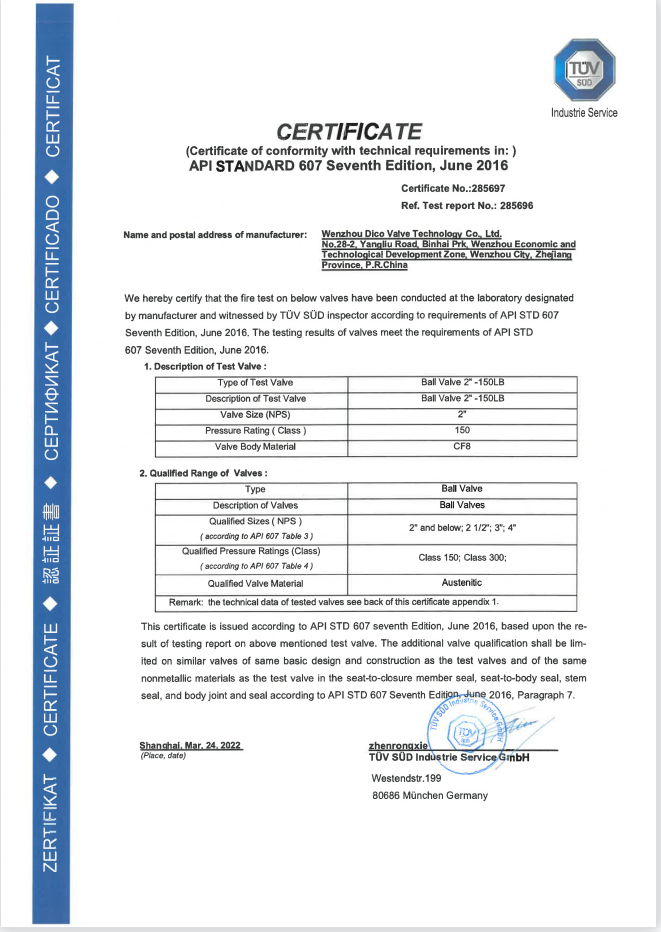
API STD 607 fire-safe test certificate 285697, issued by TÜV SÜD Industrie Service GmbH, scoped to ball valves up to 4'' in Class 150/300 austenitic material, valid until 23 March 2027.
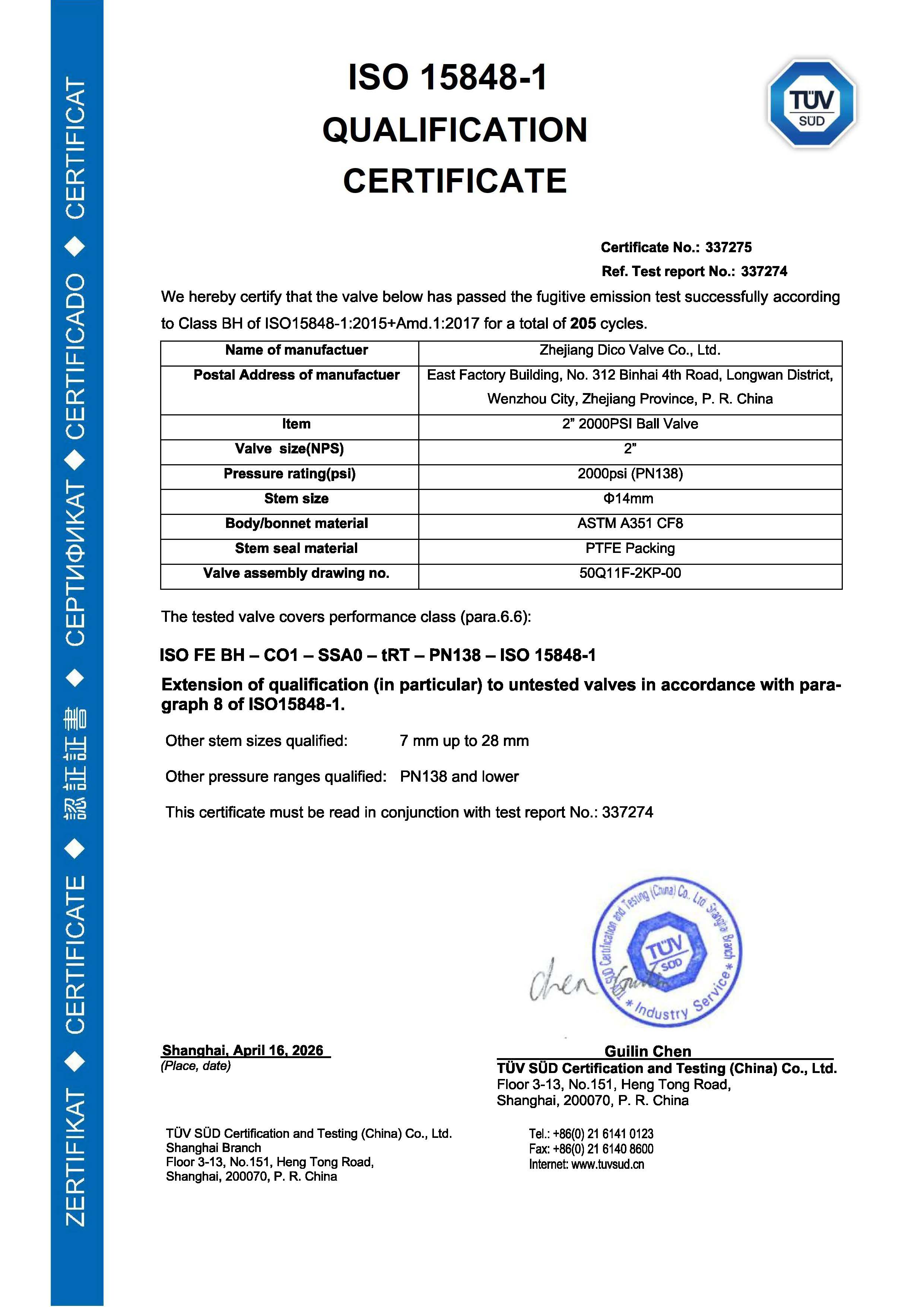
ISO 15848-1 qualification certificate 337275, issued by TUV, covering a 2'' 2000 PSI ball valve with stem size Φ7–28 mm and pressure rating PN138 and lower.
Step-by-Step: Selecting a Trunnion-Mounted Ball Valve for High-Temperature Steam
The following sequence applies Dico's published seat-selection logic to high-temperature steam service, where the temperature ceiling usually drives the whole specification.
- Fix the maximum operating temperature, not the nominal one. Use the highest temperature the valve will actually see, including temperature rise and thermal shock. This single number usually eliminates the whole soft-seat family.
- Screen the steam for cleanliness. Clean steam with a tight shut-off requirement fits the soft-seat criteria. If the line carries particles or fibrous carryover, hard seats are indicated, because particles accelerate soft-seat wear.
- Apply the pressure window. Soft seats are stated for medium-to-low pressure, Class ≤ 1500. For large diameters and high differentials, assess the opening and closing torque and select the fixed-sphere trunnion construction where needed.
- Apply the seat temperature ceiling. PEEK is stated with an upper working limit of 260 °C and PTFE creep accelerates above 200 °C. Above that point the specification belongs to the metal-seated Stellite configuration with a body material selected for elevated temperature.
- Write the tightness class into the specification. Zero leakage, Class VI, is a soft-seated attribute in the published data. Where the temperature ceiling rules out a soft seat, that trade-off should be stated explicitly in the datasheet rather than discovered at commissioning.
- Confirm the interface. Verify the flanged connection, the ISO 5211 mounting pad for the pneumatic or electric actuator, the anti-static structure, and three-layer stem sealing — the last of which is the basis of the ISO 15848-1 low-emission qualification.
- Verify the documentation. Match the certificate scope to the actual size, class and material; require ball heat-number traceability; and confirm the test regime. Dico applies a first round of 100% testing and a second round of random checks, and its published life test is a 20-second high-frequency switch test to 50,000 cycles without leakage.
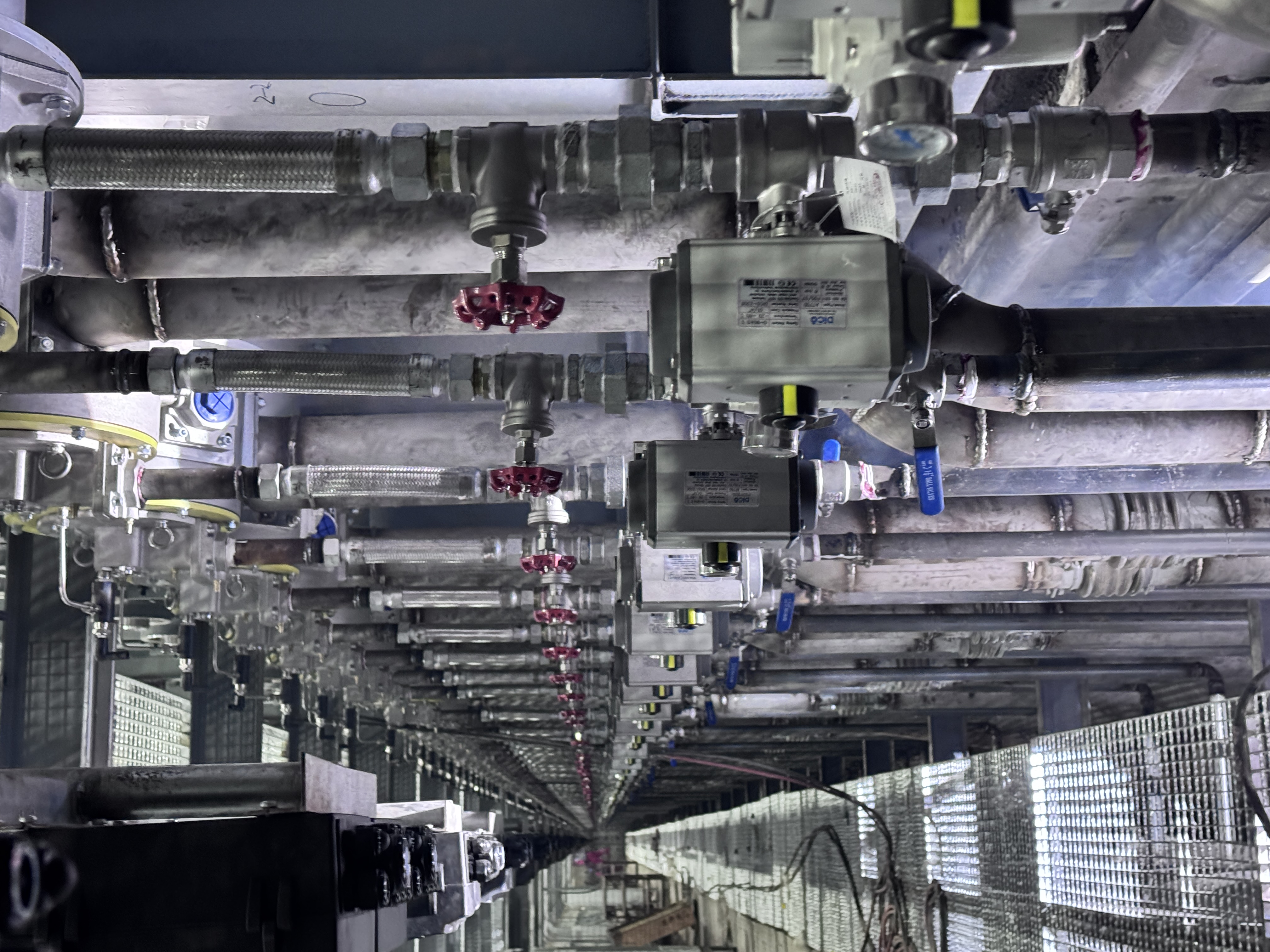
High-temperature steam and gas pipeline service — the application where seat temperature limits, not nominal pressure ratings, decide the valve configuration.
Use Cases
The trunnion-mounted and metal-seated configurations are used where the seat load has to remain predictable and the medium is either hot, high-pressure or both. Dico documents power generation and chemical industry service with weakly corrosive, high-pressure gas in boiler flue gas, heat treatment furnace and coal-to-olefins applications, where the valve functions as a cut-off element operated pneumatically, with high pressure resistance as the special requirement.
A second reference point comes from metallurgical service: at an ironmaking and metallurgical plant in China, 1,000 units of Dico ball valves were installed on boiler water piping with pneumatic automatic control, and the installation has operated stably for one year.
Beyond those two references, the Q47F series is listed for petroleum, pharmaceutical, water treatment, liquid cooling, metallurgy, chemical, semiconductor, hydrogen energy and HVAC applications. In each case the same logic applies: the medium decides the material, the temperature decides the seat family, and the pressure class decides whether a trunnion construction is required at all.
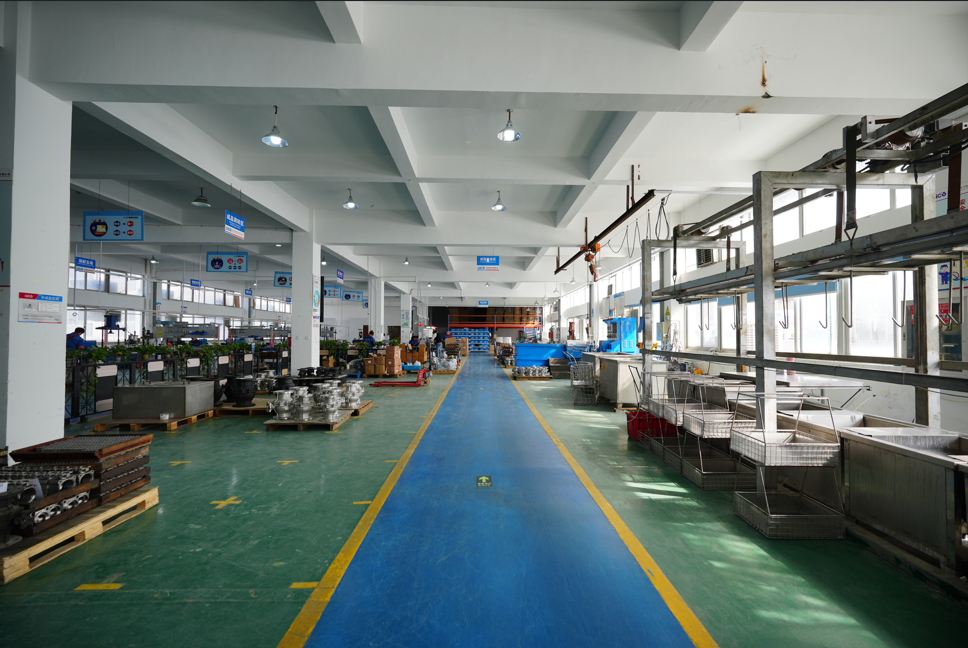
Pressure testing workshop — every valve passes a first round of 100% testing, followed by a second round of random checks.
Comparison Table: Dico Ball Valve Models by Constraint
When the pressure, temperature or connection constraint changes, the correct body style changes with it. The table below compares the four Dico ball valve series on the parameters that appear in a specification sheet.
| Model | Series | Connection | Pressure range | Temperature range | Body / ball materials | Seat options |
|---|---|---|---|---|---|---|
| Q47F | Trunnion-mounted ball valve (metal-seated / soft-seated) | Flange | 1.0–10.0 MPa | -29 °C to 425 °C | Carbon steel, SS304, SS316, dual phase steel, titanium, alloy steel | PTFE, PPL, PI, PEEK, Stellite |
| Q41F | Floating ball valve (metal-seated / soft-seated) | Flange | 1.0–10.0 MPa | -29 °C to 425 °C | Carbon steel, SS304, SS316, dual phase steel, titanium, alloy steel | PTFE, PPL, PI, PEEK, Stellite |
| Q71F | Wafer ball valve | Wafer | 1.0–4.0 MPa | -29 °C to 425 °C | Carbon steel, SS304, SS316 | PTFE, PPL, PI, PEEK, Stellite |
| Q11F | PC ball valve (includes sanitary, mini, 3-way, 4-way, ISO 5211, floating, 3PC Tri-Clamp and ANSI types) | Thread, weld, Tri-Clamp, tube, press-fit | 1.0–13.0 MPa | -196 °C to 425 °C | Carbon steel, SS304, SS316, dual phase steel | PTFE, PPL, PI, PEEK, Stellite |
Dico ball valve series compared by connection, pressure, temperature, material and seat options.
Read the table by constraint rather than by size: the wafer series stops at 4.0 MPa, the trunnion and floating series share the 10.0 MPa ceiling, and the PC series reaches 13.0 MPa and the widest temperature span because it covers threaded, welded, Tri-Clamp and press-fit sanitary constructions. Pressure capability alone does not decide the family — differential pressure, bore size and actuator torque requirement do.
FAQ
What should I check when comparing API 6D high-quality ball valve manufacturers?
Compare certification scope, not certificate count. Dico's certification set includes ISO 9001, ISO 14001, API 6D, CE, SIL, ISO 15848 and API 607, but the decisive detail is what each document covers. The API STD 607 fire-safe test certificate, number 285697, is scoped to ball valves in 2'' and below, 2-1/2'', 3'' and 4'', Class 150 and Class 300, austenitic material, valid until 23 March 2027. The ISO 15848-1 qualification certificate, number 337275 issued by TUV, is scoped to a 2'' 2000 PSI ball valve with stem size Φ7–28 mm and pressure rating PN138 and lower. Ask every supplier for the scope line, the issuing body and the certificate number, and match them against your size, class and material.
What pressure and temperature limits apply to the Dico Q47F trunnion-mounted ball valve?
The Q47F is rated from 1.0 to 10.0 MPa and -29 °C to 425 °C, and can be built in carbon steel, SS304, SS316, dual phase steel, titanium or alloy steel with PTFE, PPL, PI, PEEK or Stellite seats. The 425 °C figure is the top of the assembly envelope, not a soft-seat rating: PEEK is stated with an upper working limit of 260 °C and PTFE creep accelerates above 200 °C, so high-temperature points are normally served by the metal-seated configuration. The related certification scope for industrial valves is DN ≤ 400 mm and PN ≤ 13.0 MPa.
How do I select the valve seat for a high-temperature steam ball valve?
Work through four dimensions in order — temperature, medium, pressure and corrosion — and let each one narrow the options. Soft-seated valves fit clean media requiring zero leakage (Class VI), operating temperature up to 260 °C, medium-to-low pressure at Class ≤ 1500, frequent cycling where low torque matters, and highly corrosive media handled by PTFE or FKM. Check the failure modes as well: particles and fibrous media require hard seats, glass-fiber PTFE is not resistant to HF or strong alkalis, and rubber-type materials must be confirmed against chemical compatibility tables rather than assumed.
What are the minimum order quantity, lead time and production capacity?
Dico accepts a minimum order quantity of 1 unit, with lead times of 7 to 45 days depending on configuration, and a monthly capacity of 10,000 units. Both OEM and ODM production are supported, with customization available in appearance, material, logo and mold. For buyers building a specification rather than placing a single order, the practical approach is to confirm the seat and body combination first, because that is what sets the lead time.
Can I validate a trunnion-mounted ball valve with a sample before a volume order?
Yes — the 1-unit minimum order quantity is intended for exactly this. Quality control runs a first round of 100% testing followed by a second round of random checks, and the published life test is a 20-second high-frequency switch test to 50,000 cycles without leakage. Valves carry a 12-month warranty with replacement rather than repair for quality issues, and after-sales issues are targeted for resolution within 48 hours; warehouse management uses a one-item-one-code system with 98% data accuracy, which supports repeat orders of the same configuration. To request a sample, a quotation or the full company profile, contact marisa@dicovalve.com or evan@dicovalve.com, or download the Dico brief introduction.
Conclusion
Trunnion-mounted ball valve selection is a constraint exercise, and the constraints arrive in a fixed order: bodies and balls are chosen by medium, seats are chosen by temperature and cleanliness, pressure class decides whether the fixed-sphere construction is required, and certification scope decides whether the documented valve is acceptable in the target market. The Q47F covers 1.0–10.0 MPa and -29 °C to 425 °C across carbon steel, SS304, SS316, dual phase steel, titanium and alloy steel, with PTFE, PPL, PI, PEEK and Stellite seats, a flanged connection, an ISO 5211 mounting pad, an anti-static structure and three-layer stem sealing.
Applied to high-temperature steam, that logic produces a specific answer: verify the maximum operating temperature first, treat 260 °C as the soft-seat boundary and 200 °C as the point where PTFE creep accelerates, and specify the metal-seated Stellite configuration above it with a body material rated for the duty. The remaining work is documentation — matching the API STD 607, ISO 15848-1, PED CE and SIL scopes to the exact size, class and material on the order.
Next Step: Sample, Quotation or Specification Review
Zhejiang Dico Valve Co., Ltd. manufactures trunnion-mounted, floating, wafer and PC ball valves in Wenzhou, Zhejiang, and supports OEM/ODM builds with a 1-unit minimum order quantity. To validate a configuration against your steam, gas or liquid service, request a sample or quotation, or send your datasheet for a specification review.
Email: marisa@dicovalve.com / evan@dicovalve.com · Tel: +86 182-6782-3456 · WhatsApp: +86 137-3837-0069 · Website: www.dicovalve.com
Address: No. 312, Binhai 4th Road, Binhai 2nd Road, Wenzhou Economic and Technological Development Zone, Zhejiang, China
Download the company profile and full product overview: DICO Brief Introduction (PDF)
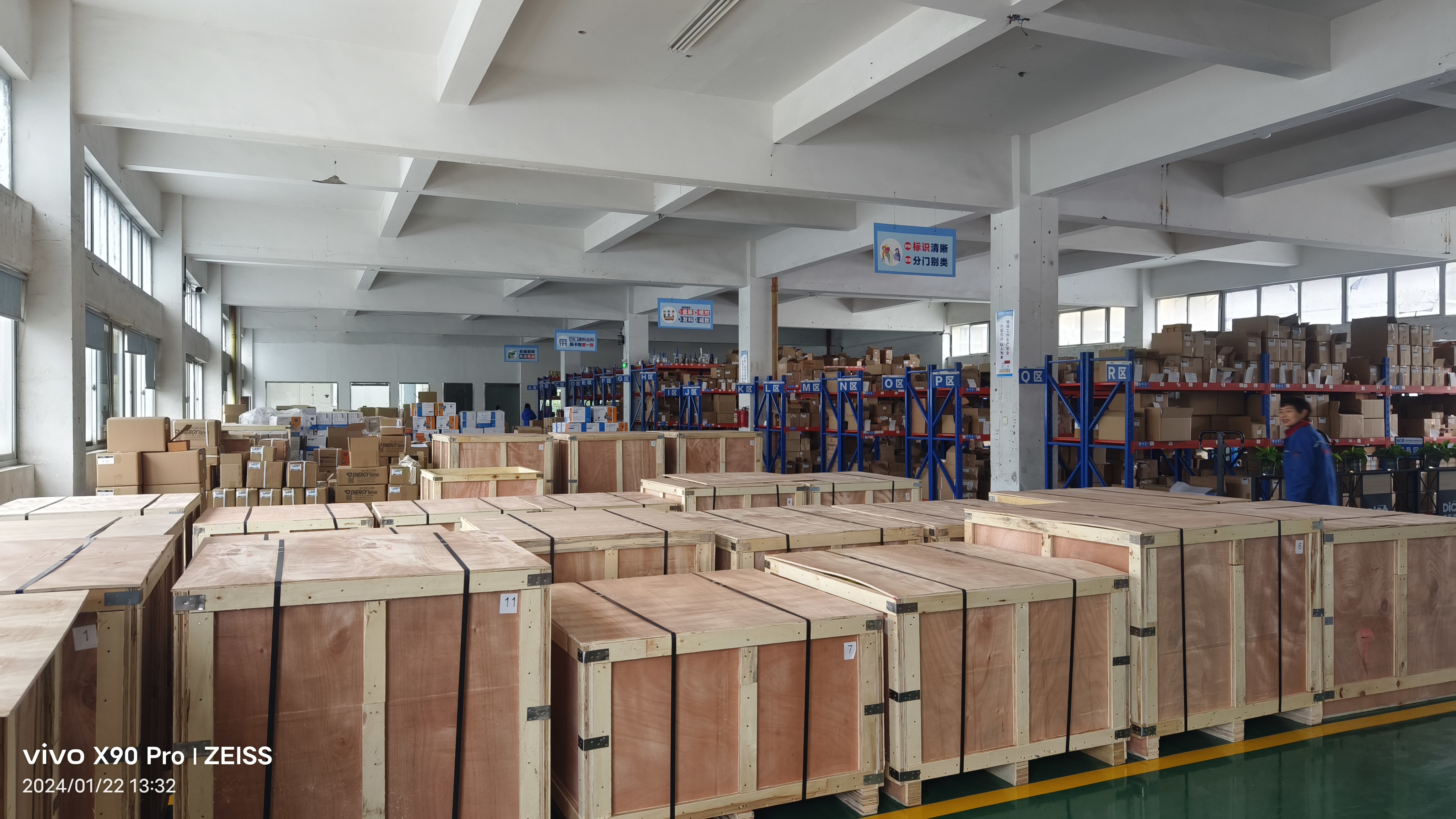
Orders prepared for shipment — one-item-one-code warehousing and 98% warehouse data accuracy support repeat orders of the same configuration.
Have Questions or Need More Details?
Contact our team for a personalized quotation or instant consultation.
Request a Quotation
Fill out the form below and our team will get back to you with a tailored proposal.
WhatsApp Direct Chat
Prefer to chat in real-time? Message us on WhatsApp for instant assistance & quick answers.
- Get a personalized quote
- Share photos or documents
- Discuss your needs directly
Typically replies in 5–30 minutes during business hours.