
Trunnion-Mounted vs Three-Way Ball Valve: Choosing the Right High-Quality Valve for Your System
The Q47F trunnion-mounted ball valve and the Q44F three-way ball valve are not competing versions of the same product. The Q47F, manufactured by Zhejiang Dico Valve Co., Ltd., is a flanged two-port isolation valve rated from 1.0 to 10.0 MPa and −29°C to 425°C. The Q44F is a multi-port flow-directing valve supplied in L-type and T-type configurations. The choice between them is decided by a single question: does the system need to shut off high-pressure flow in a straight run, or does it need to move flow between two or three paths?
Why this comparison goes wrong before the specification starts
Wrong valve selections in this category are rarely caused by a wrong material or an incorrect size. They are caused by treating “ball valve” as one product family.
A ball valve performs one of two fundamentally different jobs:
- Isolation. The valve sits in a straight pipeline and starts or stops the flow of a medium. Pressure containment, seat tightness and fire safety are the governing requirements. The trunnion-mounted design belongs here.
- Flow direction. The valve sits at a junction and routes, splits, blends or switches the medium between pipe paths. Port arrangement and switching logic are the governing requirements. The three-way design belongs here.
When a three-way valve is specified for a high-pressure isolation duty, the problem is not the valve’s quality — the valve simply cannot perform the job. When a trunnion-mounted isolation valve is specified where the process needs two parallel loops switched, the failure is the same in the opposite direction. The specification breaks before the purchase order is written, and the cost shows up later as rework, downtime or an unplanned change order.
Industry background: where ball valve demand is concentrating
Global Market Insights estimates the global ball valve market at USD 12.6 billion in 2025, reaching USD 22.8 billion by 2035. Within that market, Straits Research reports that floating ball valves held a 61.8% share by type in 2025 — a reminder that most installed ball valves are general-duty designs, while high-pressure trunnion-mounted and multi-port three-way valves serve a narrower but more demanding slice of the market.
Two application segments are adding specification complexity. MarketsandMarkets projects the data center liquid cooling valve market to grow from USD 0.27 billion in 2025 to USD 1.80 billion by 2032, which pushes small-bore and leak-tight ball valve requirements into markets that previously bought on price alone. In pharmaceutical service, Market Research Insights reports that SS316L and SS304 accounts for 68% of valves used in that segment, making material documentation a routine part of the purchase file.
Regulation is moving in the same direction. API 6D Addendum 3 became effective in September 2025 for pipeline valves through the American Petroleum Institute. The practical consequence for buyers is that certification presence is no longer sufficient evidence; certification scope — size range, pressure class, material group and expiry date — now has to be checked against the actual duty.
The Q47F trunnion-mounted ball valve: engineered for high-pressure shutoff
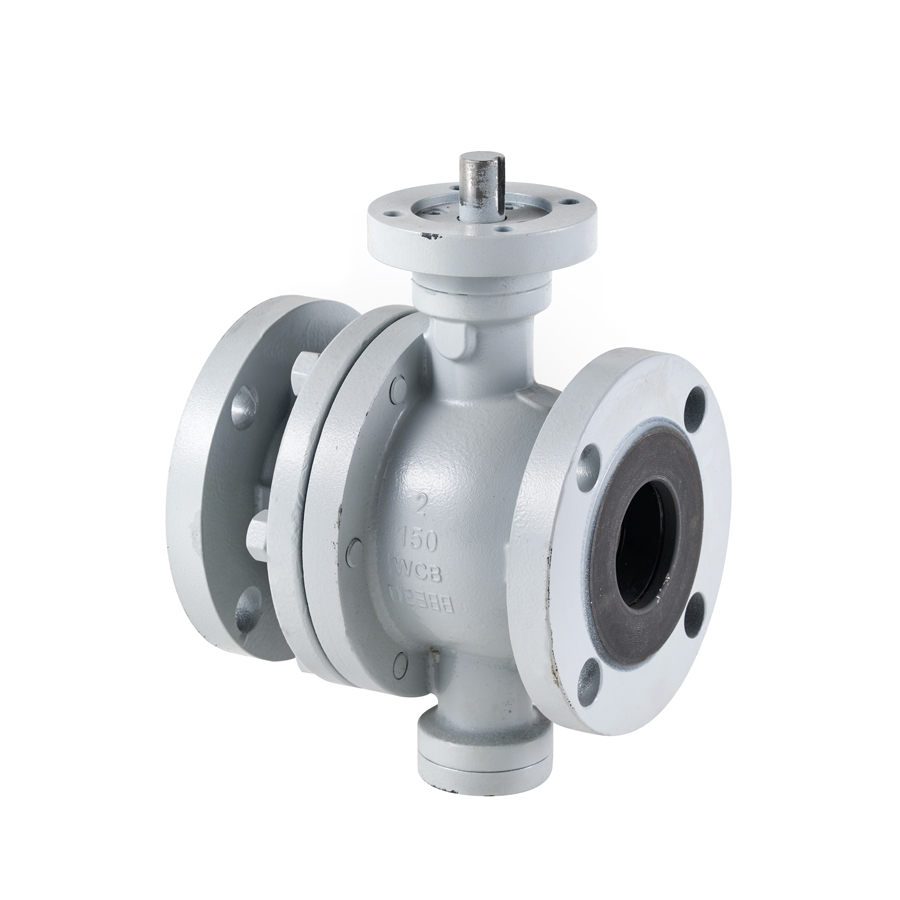
The Q47F is a flanged trunnion-mounted ball valve listed in both the metal-seated and soft-seated ball valve categories, depending on the seat material selected. In a trunnion-mounted valve the ball is mechanically supported at top and bottom instead of being pressed against the seat by line pressure alone. That structural difference is the reason this family is used where the operating pressure is high enough that seat loading and operating torque would otherwise become unmanageable.
Operating envelope
- Pressure range: 1.0–10.0 MPa
- Temperature range: −29°C to 425°C
- Connection: flanged
- Body materials: carbon steel, SS304, SS316, dual phase steel, titanium, alloy steel
- Seal materials: PTFE, PPL, PI, PEEK, Stellite
- Ball options: hollow ball or solid ball
- Typical industries stated for this model: petroleum, pharmaceuticals, water treatment, liquid cooling, metallurgy, chemicals, semiconductors, hydrogen energy and HVAC
Design features that carry real procurement meaning
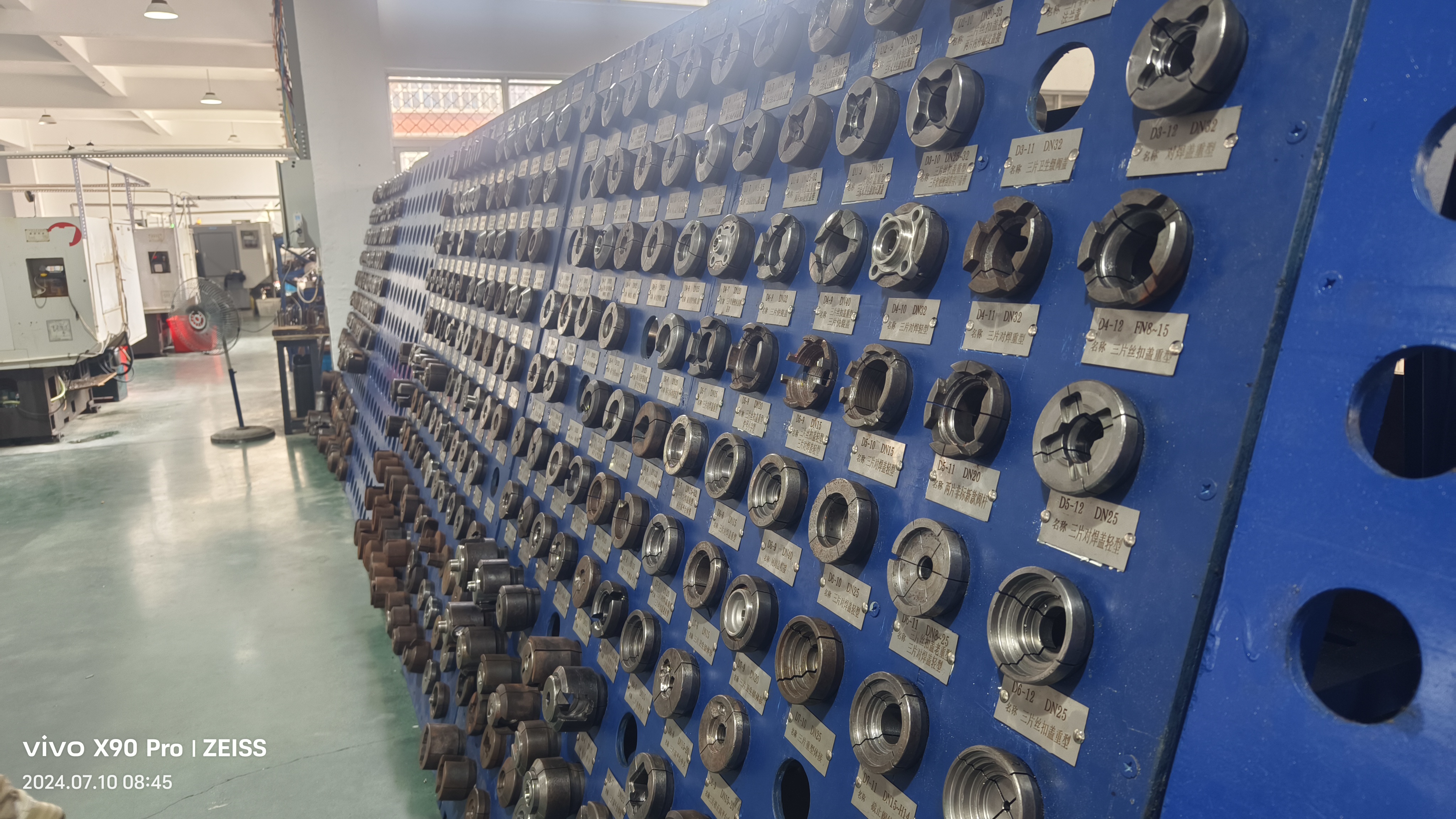
The Q47F is built with an ISO 5211 mounting pad, so a pneumatic or electric actuator can be mounted directly without a custom bracket. It uses an anti-static structure and three-layer sealing of the valve stem, both of which matter where static discharge or stem-leak paths are a documented risk. The ball is supplied with heat number traceability, so the material history of the sealing element can be traced back through the supply chain. Seat and seal components use Daikin PTFE with machining, precision-machined seals with a smooth surface and high precision, and high-precision spherical polishing of the ball. The flange outer circle is machined and the body is heavier than the manual series, with a thicker flange standard.
Certification portfolio covering the Q47F
Four certificates in the Dico portfolio list the trunnion-mounted ball valve as an applicable product:
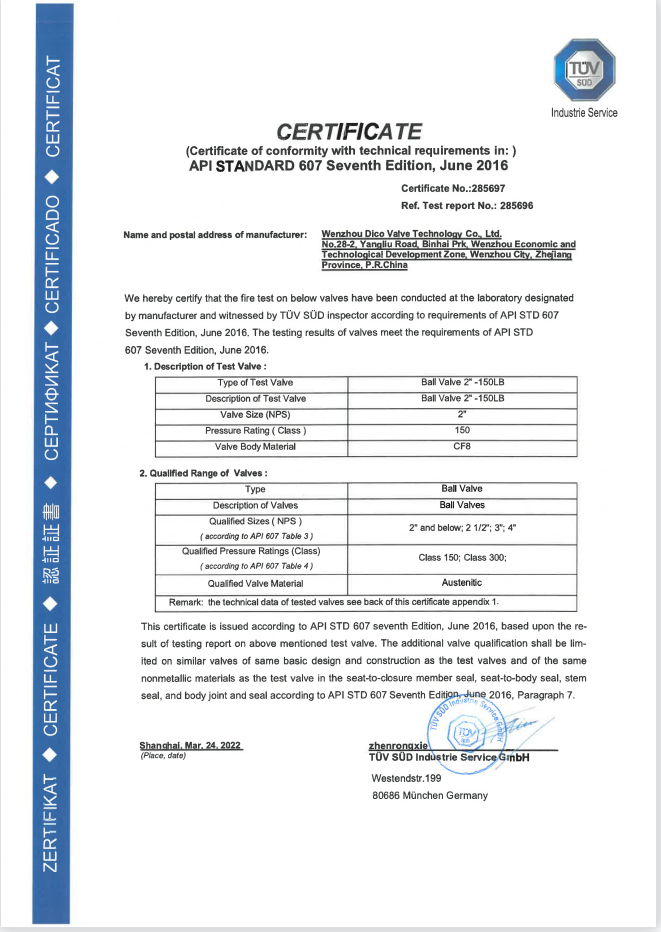
- API STD 607 Fire-safe Test Certificate. Issued by TÜV SÜD Industrie Service GmbH, certificate number 285697, valid until 23 March 2027. The scope covers ball valves through 4 inch, in Class 150 and Class 300, austenitic material. The same certificate also applies to the floating ball valve, the PC ball valve and the wafer ball valve.
- ISO 15848-1 Qualification Certificate. Issued by TUV, certificate number 337275, against ISO 15848-1:2015+Amd.1:2017. The certificate scope is a 2 inch 2000 PSI ball valve, stem size Φ7–28 mm, pressure rating PN138 and lower, valid for the EU, North America, South Africa and South America markets.
- Functional Safety Certificate. Issued by ECM, certificate number 6L241216.ZDVWQ00, against IEC 61508:2010 Parts 1–7. Scope: industrial valve, DN ≤ 400 mm, PN ≤ 13.0 MPa, SIL3 capable. Valid until 15 December 2029.
- PED CE Verification Certificate. Issued by Ente Certificazione Macchine Srl (ECM), certificate number 6L241216.XSVWQ18, against EN 12266:2012 and PED Directive 2014/68/EU. Scope: industrial valve, DN ≤ 400 mm, PN ≤ 13.0 MPa, for the EU market.
At company level, Zhejiang Dico Valve Co., Ltd. operates an ISO 9001:2015 quality management system (certificate 20225Q20008R0M), an ISO 14001:2015 environmental management system (certificate 20225E20003R0M) and an ISO 45001:2018 occupational health and safety management system (certificate 20225S20004R0M), all issued by Zhejiang QPC Certification Co., Ltd. and covering the production and sales of metal valves.
The Q44F three-way ball valve: engineered for flow diversion
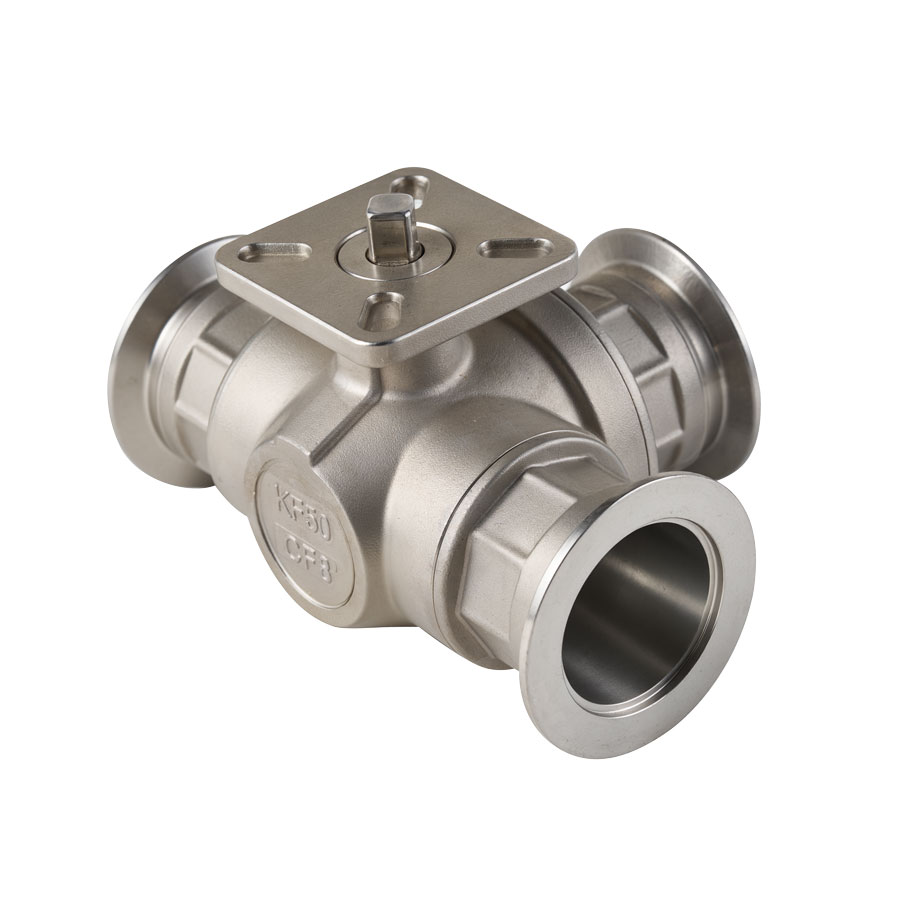
Q44F is a three-way ball valve available in L-type and T-type configurations, with either flange or clamp connections. Where the Q47F answers the question “should this line be open or closed,” the Q44F answers the question “which path should the medium take right now.”

Configuration and build
- Types: L-type and T-type
- Body materials: carbon steel, SS304, SS316
- Connections: flange or clamp
- Seal materials: PTFE, PPL, PI, PEEK, Stellite
- Ball options: hollow ball or solid ball
- Stated applicable industries: petroleum, pharmaceuticals, water treatment, liquid cooling, metallurgy, chemicals, semiconductors, hydrogen energy and HVAC
L-type and T-type are two different internal flow-path arrangements inside the same valve body. The arrangement determines which ports are connected at each quarter turn, so the correct selection depends on the switching logic drawn on your P&ID — diverting flow between two outlet paths, or distributing flow across three ports. Confirm the port arrangement drawing with the supplier before ordering rather than assuming the two types are interchangeable, because the difference is invisible from the outside of the valve.
Manufacturing features carried into the three-way body
The Q44F shares the same manufacturing platform as the Dico isolation series: an ISO 5211 mounting pad, a machined flange outer circle, a body heavier than the manual series, a thicker flange standard, an anti-static structure and three-layer stem sealing. The ball is sourced from a high-end supplier with heat number traceability, seats use Daikin PTFE with machining, seals are precision-machined with a smooth surface and high precision, and the ball is spherically polished to high precision.
Step-by-step: how to specify between the two
Step 1 — Write the function in one sentence
Complete the sentence “this valve must ____” with either “stop or start flow in this line” or “send flow to path A, path B or both.” The first answer points to the Q47F; the second points to the Q44F. Do this before opening any datasheet.
Step 2 — Fix the pressure and temperature envelope
For the Q47F, the stated envelope is 1.0–10.0 MPa and −29°C to 425°C. Compare that against the maximum operating pressure and the maximum operating temperature of the duty, not the nominal line conditions. Where the two do not overlap comfortably, the design family — not the vendor — is usually the constraint.
Step 3 — Choose the flow path
For a two-port isolation valve this step is a straight-through decision. For a three-way valve, it means choosing between L-type and T-type and then confirming the port arrangement against the P&ID. Getting this wrong produces a valve that opens and closes correctly but routes flow incorrectly.
Step 4 — Match the seat and seal material to the medium
This is where the largest number of avoidable failures originates. Dico’s published selection guidance for soft-seal valve seats identifies the conditions where a soft seal is appropriate: clean media requiring zero leakage (Class VI), an operating temperature up to 260°C where PEEK is the upper limit, medium-to-low pressure conditions of Class 1500 or lower, and frequent opening and closing where low operating torque is required. Highly corrosive media are served by PTFE or FKM seals.
The same guidance sets out the corresponding cautions. PTFE creep accelerates above 200°C. Particles are a main cause of soft-seal wear, and fibrous media generally require a hard seal instead. Pure PTFE cold-flows under high pressure, so large-diameter and high-differential applications should be assessed for operating torque and may require a mechanically supported ball structure — the reason the trunnion-mounted Q47F exists as a separate platform. Glass-fibre PTFE is not resistant to HF or strong alkalis, and rubber seals must be selected from chemical compatibility tables rather than from experience.
Step 5 — Decide between manual and actuated operation
Both the Q47F and the Q44F are built with an ISO 5211 mounting pad, so actuation can be added without a bespoke mounting kit. Record the actuation decision at specification stage, because the actuator interface, stroke and fail position affect the bracket and coupling that are ordered with the valve.
Step 6 — Verify certification scope against the destination market
Check the certificate number, the covered size and pressure class, the material group and the expiry date for the exact model being purchased. A fire-safe certificate that covers a 4 inch Class 300 austenitic body does not automatically cover a different size, class or material group.
Step 7 — Validate with a sample and test documentation
Ask for the sample, the pressure test record and the material certificate before releasing a production order. Dico applies a two-round quality control process: a first round of 100% testing and a second round of random checks. The service life benchmark used in production is a 20-second high-frequency switch test, with 50,000 cycles without leakage.
Step 8 — Confirm MOQ, lead time and stock position
Dico quotes an MOQ of 1 unit and a standard lead time of 7–45 days, supported by a monthly capacity of 10,000 units. A 2,000 m² warehouse holds standard product blank inventory for stable delivery, managed on a one-item-one-code system with 98% warehouse data accuracy.
Where each valve earns its place
High-pressure gas cut-off in power generation and chemical plants
The recorded application profile for this duty is a weakly corrosive, high-pressure gas service in power generation and chemical industry plants, covering boiler flue gas, heat treatment furnace and coal-to-olefins project types, with pneumatic operation and a stated special requirement of high pressure resistance. This is isolation duty, and it is the case the trunnion-mounted platform is built for.
Boiler water piping in ironmaking and metallurgy
Dico’s case record for an ironmaking and metallurgical plant covers 1,000 units supplied for boiler water piping with pneumatic automatic control, reported as stable operation over a one-year period. The value of this record for a buyer is not the unit count; it is the evidence that automated ball valve packages are being supplied in continuous-duty process service rather than single-shot projects.
Loop switching in pharmaceutical and water treatment circuits
Where a process must alternate between parallel filters, tanks or distribution branches without stopping the main flow, the three-way Q44F performs the switching function in a single body and removes the need for two isolation valves and a tee. The stainless-steel body options and the same seal set as the isolation series keep the spare-parts position simple.
Liquid cooling and semiconductor support systems
Both designs list liquid cooling, semiconductor and hydrogen energy among their stated industries. In these circuits the selection is usually decided by the leak-tightness requirement and the space available at the manifold, which is why the three-way configuration and the low-emission certification of the trunnion platform are frequently specified together on the same project.
Q47F vs Q44F: head-to-head comparison
| Specification | Q47F Trunnion-Mounted Ball Valve | Q44F Three-Way Ball Valve |
|---|---|---|
| Primary function | On/off isolation and high-pressure shutoff in a straight pipeline run | Flow diversion, splitting, blending or switching between ports |
| Flow configuration | Two-port straight-through, flanged | L-type and T-type multi-port |
| Connection | Flanged | Flange or clamp |
| Pressure range | 1.0–10.0 MPa | Specify the required rating at inquiry |
| Temperature range | −29°C to 425°C | Specify the required range at inquiry |
| Body materials | Carbon steel, SS304, SS316, dual phase steel, titanium, alloy steel | Carbon steel, SS304, SS316 |
| Seal materials | PTFE, PPL, PI, PEEK, Stellite | PTFE, PPL, PI, PEEK, Stellite |
| Ball options | Hollow ball or solid ball | Hollow ball or solid ball |
| Actuation interface | ISO 5211 mounting pad | ISO 5211 mounting pad |
| Anti-static structure | Yes | Yes |
| Stem sealing | Three-layer sealing | Three-layer sealing |
| Fire-safe certification | API STD 607, TÜV SÜD, certificate 285697, valid to 23 March 2027; ball valves to 4 inch, Class 150/300, austenitic material | Not listed in the API STD 607 certificate scope used for this comparison — confirm the certificate scope in writing |
| Low-emission certification | ISO 15848-1, TUV, certificate 337275 | Confirm the certificate scope in writing |
| Functional safety | IEC 61508:2010 Parts 1–7, ECM certificate 6L241216.ZDVWQ00, SIL3 capable, DN ≤ 400 mm, PN ≤ 13.0 MPa | Confirm the certificate scope in writing |
| Typical duty | High-pressure gas and steam isolation, boiler and furnace piping, power generation, chemical process lines | Loop switching, blending, sampling and distribution branches in pharmaceutical, water treatment, liquid cooling and general process service |
Frequently asked questions
Is the Q47F trunnion-mounted ball valve fire-safe certified, and which standard applies?
Yes. The Q47F trunnion-mounted ball valve is certified to the API STD 607 Fire-safe Test Certificate. The certificate is issued by TÜV SÜD Industrie Service GmbH under certificate number 285697 and is valid until 23 March 2027. Its scope covers ball valves through 4 inch, in Class 150 and Class 300, austenitic material. The same certificate also applies to the floating ball valve, the PC ball valve and the wafer ball valve models. If the duty requires a fire-safe certificate for a three-way valve, ask for the certificate scope in writing before ordering, because the Q44F is not named in the API STD 607 scope used for this comparison.
API 6D high-quality ball valve manufacturers — what should a buyer verify?
A buyer evaluating API 6D high-quality ball valve manufacturers should verify a document set rather than a single claim: API 6D capability; an API STD 607 fire-safe certificate with its number, size and class scope; an ISO 15848-1 low-emission qualification with its stem-size and pressure limits; a SIL functional safety certificate to IEC 61508; a PED CE verification certificate for EU shipments; and a current quality management system certificate. Zhejiang Dico Valve Co., Ltd. holds API 6D, API 607, SIL and ISO 9001 certification. Its ISO 15848-1 certificate number is 337275, its API STD 607 certificate number is 285697, and its ISO 9001:2015 certificate 20225Q20008R0M is issued by Zhejiang QPC Certification Co., Ltd. Because API 6D Addendum 3 became effective in September 2025 for pipeline valves, documentation should also be checked against the current edition of the standard.
Can both the Q47F and the Q44F be fitted with an actuator?
Yes. Both models are built with an ISO 5211 mounting pad, which is the standardised interface that allows a pneumatic or electric actuator to be mounted without a custom-machined bracket. Dico’s case record for an ironmaking and metallurgical plant covers 1,000 units supplied for boiler water piping with pneumatic automatic control and reported as stable operation over one year, which is direct evidence of automated ball valve packages running in continuous process service.
What is the minimum order quantity and lead time for a high-quality ball valve order?
The MOQ is 1 unit and the standard lead time is 7–45 days, depending on configuration and material. Monthly production capacity is 10,000 units. A 2,000 m² warehouse holds standard product blank inventory to support stable delivery, managed on a one-item-one-code system with 98% warehouse data accuracy, and 48 CNC machines run under digital production management. Customization is available for appearance, material, logo and mould under OEM and ODM production. Where the required configuration is a non-standard L-type or T-type port arrangement, lead time should be confirmed against the drawing before the order is placed.
How do I validate a valve before committing to a full production order?
Request a sample together with the pressure test record and the material certificate. Dico applies a two-round quality control process — a first round of 100% testing and a second round of random checks — and uses a 20-second high-frequency switch life test with 50,000 cycles without leakage as the production benchmark. Every valve carries a 12-month warranty with replacement rather than repair for quality issues, and after-sales questions are resolved within 48 hours. To start, send your duty, medium, pressure, temperature and port arrangement to marisa@dicovalve.com or evan@dicovalve.com, or message the Dico Valve team on WhatsApp at +86 137-3837-0069. The full product range is summarised in the Dico Valve product brochure.
Conclusion
The trunnion-mounted versus three-way question is answered before either valve is opened. If the system must isolate high-pressure media in a straight run, the Q47F trunnion-mounted ball valve is the correct family, with its 1.0–10.0 MPa and −29°C to 425°C envelope, its PTFE, PPL, PI, PEEK and Stellite seat options, its ISO 5211 interface, its anti-static structure and three-layer stem sealing, and its API STD 607 fire-safe certificate number 285697. If the system must divert, split or switch flow between paths, the Q44F three-way ball valve is the correct family, in L-type or T-type, with carbon steel, SS304 or SS316 bodies and flange or clamp connections.
Everything after that first decision — seat material, actuation, certification scope, sample validation, lead time — is a checking exercise rather than a judgement call. Confirm the certificate scope against the size, class and material actually being purchased, and confirm the port arrangement against the P&ID before the order is issued.
Send us your duty and we will confirm the right valve
Zhejiang Dico Valve Co., Ltd. manufactures high-quality ball valves and fluid control solutions from Wenzhou, Zhejiang, serving the EU, North America and South Africa markets. Send the medium, pressure, temperature and flow arrangement of your application, and the Dico team will confirm whether the Q47F trunnion-mounted ball valve or the Q44F three-way ball valve matches the duty.
Email: marisa@dicovalve.com | evan@dicovalve.com | WhatsApp: +86 137-3837-0069
Website: www.dicovalve.com | Download the Dico Valve brochure
Have Questions or Need More Details?
Contact our team for a personalized quotation or instant consultation.
Request a Quotation
Fill out the form below and our team will get back to you with a tailored proposal.
WhatsApp Direct Chat
Prefer to chat in real-time? Message us on WhatsApp for instant assistance & quick answers.
- Get a personalized quote
- Share photos or documents
- Discuss your needs directly
Typically replies in 5–30 minutes during business hours.