High-Quality Ball Valve Supplier Vetting: Certificates, Materials, Delivery Proof
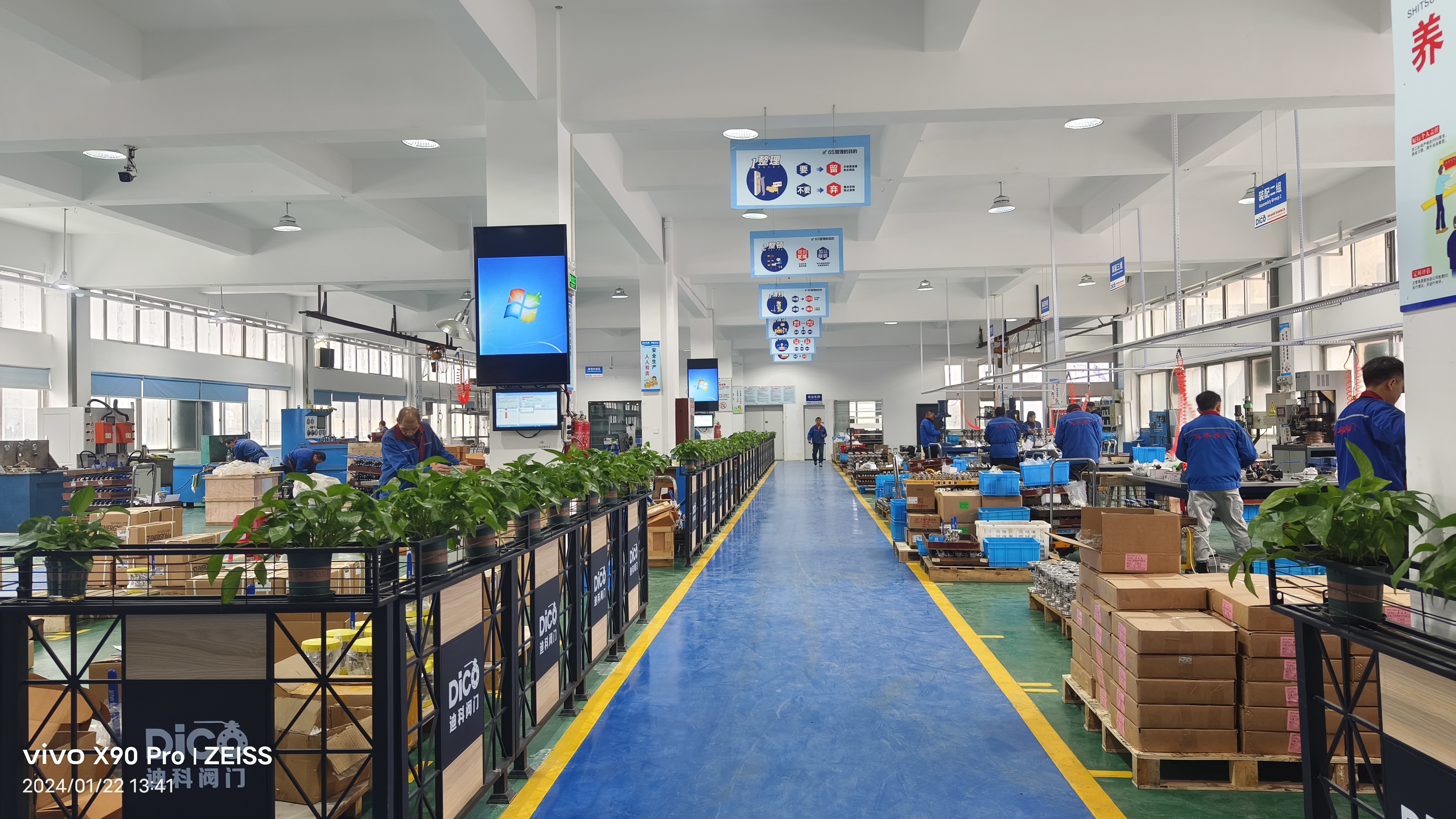
Assembly workshop, Zhejiang Dico Valve Co., Ltd (Wenzhou, Zhejiang, China). Supplier vetting begins with what can be verified at the source, not with the quotation sheet.
Short answer: a high-quality ball valve supplier is one whose certificates apply to the exact model, size, pressure class and material you are buying; whose body material and seal combination match your media and temperature; and whose delivery promise is backed by production capacity, stock records and a defined warranty. Vetting against those three pillars takes roughly the same time as comparing quotations — it simply moves the risk check to before the purchase order instead of after installation.
Buyers searching for a high-quality ball valve supplier usually start with the same two questions: who makes them, and how do I tell one apart from the rest? The practical answer is that “high quality” is not a supplier attribute. It is a claim about a specific valve — a model number, a body material, a seal composition, a pressure class and a test record — and it can only be checked item by item.
The Vetting Problem: What a Unit Price Conceals
A ball valve quotation is a single number. Behind that number sit at least four variables that determine whether the valve performs for a decade or fails in the first quarter:
- Certificate scope. A supplier can hold a company-level quality certificate and still quote a valve model that sits outside the scope of its product-level certification. The certificate is real; the coverage claim is not.
- Material designation. “Stainless steel” on a quotation is not a specification. SS304, SS316, dual phase steel, titanium and alloy steel behave differently under the same media and temperature.
- Seal composition. Two valves with identical body castings can differ by a factor in service life depending on whether the seat is PTFE, PPL, PI, PEEK or Stellite, and on how the stem is sealed.
- Delivery reality. A quoted lead time is a projection. Whether it holds depends on machining capacity, whether standard bodies are held as blanks in stock, and whether the supplier can trace an individual order through production.
None of these four can be settled by comparing prices. They can all be settled with about twenty minutes of structured questioning, which is what the framework below is built to do.
Industry Background: Why Vetting Standards Are Tightening
Three shifts in the ball valve market are making certificate and delivery verification more consequential than it was a decade ago.
First, the installed base keeps growing. Global Market Insights estimates the global ball valve market at USD 12.6 billion in 2025, reaching USD 22.8 billion by 2035. Within that volume, Straits Research reported that floating ball valves accounted for 61.8% of the global market in 2025 — meaning the majority of purchase decisions in this category are made on a design that is simple, widely manufactured, and therefore easy to specify badly.
Second, niche demand is pulling in a different set of requirements. MarketsandMarkets projected the data center liquid cooling valve market to grow from USD 0.27 billion in 2025 to USD 1.80 billion by 2032. Liquid cooling procurement rewards suppliers who can demonstrate small-bore precision, clean assembly and repeatable leak performance — not generic valve catalogues.
Third, the standards themselves keep moving. API 6D Specification Addendum 3 became effective in September 2025 for pipeline valves. Buyers working from a two-year-old technical requirement sheet may already be specifying against a superseded baseline.
In regulated segments the material question is equally settled. Stainless steel 316L and 304 together account for approximately 68% of valves used in the pharmaceutical market — a concentration that tells you what auditors expect to see in a material certificate for a hygienic line.
The Vetting Framework: Three Pillars
Pillar 1 — Certificates: Map Evidence to the Product, Not the Company
The single most common vetting error is treating a certificate as a blanket approval. It is not. Certificates divide into two classes, and they answer different questions.
Company-level management certificates — such as ISO 9001 for quality management and ISO 14001 for environmental management — indicate that the supplier's processes are audited and controlled. They say nothing about whether a specific valve model passed a specific performance test.
Product-level certificates and approvals tell you what a valve family has been tested to, and under what limits. Among the certifications held by Zhejiang Dico Valve Co., Ltd are ISO9001, ISO14001, API 6D, CE, SIL, ISO 15848 and API 607. API 607, for example, is a fire-safe test standard; a certificate against it is meaningful only when you also know the size, pressure class and material it covers.
That is exactly the level of detail a buyer should demand. For Dico, API 607 certification covers austenitic material ball valves up to 4 inches, Class 150/300, and is valid until March 2027. If your project calls for a 6-inch Class 600 carbon steel valve in fire-safe service, that certificate does not carry the claim for you — and a credible supplier will say so rather than let you assume otherwise.
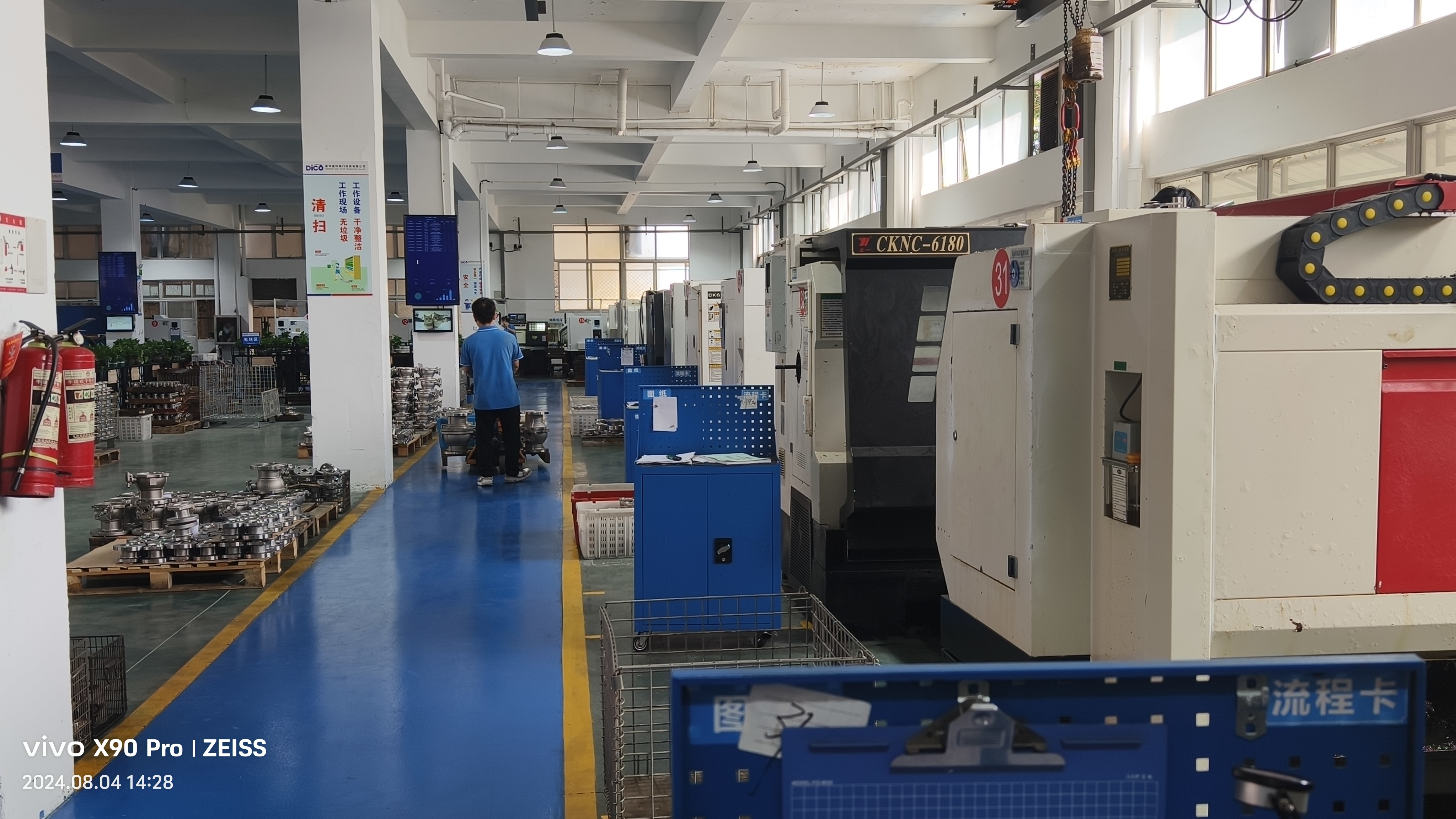
Certificate scope is only credible when production is repeatable. Dico operates 48 CNC machines with digital production management.
A workable certificate checklist for a ball valve supplier looks like this:
- Company management system certificates (ISO 9001, ISO 14001) — valid and current.
- Design and testing standard certificates relevant to the valve family (for example API 6D for pipeline valves, with attention to the current addendum).
- Fire-safe testing (API 607) — with the size range, pressure class and material composition stated.
- Fugitive emission certification (ISO 15848) — relevant wherever low-emission service is specified.
- Functional safety certification (SIL) — relevant to safety instrumented loops rather than to ordinary isolation duty.
- Market access marking (CE) for EU-bound shipments, alongside the supplier's stated export profile.
Pillar 2 — Materials and Seals: Match the Valve to the Duty
Material vetting is where technical buyers earn their value. The relevant question is never “what materials do you offer?” but “which material and seal combination do you recommend for this media, this temperature and this pressure, and why?”
Take the trunnion-mounted ball valve. The Q47F trunnion-mounted ball valve bodies are available in carbon steel, SS304, SS316, dual phase steel, titanium or alloy steel, with a flanged connection, a pressure range of 1.0 to 10.0 MPa and a temperature range of −29°C to 425°C. Seal materials include PTFE, PPL, PI, PEEK and Stellite, and the ball may be hollow or solid. Both soft-seated and metal-seated versions are offered.
That single paragraph already answers most of a material vetting conversation. A −29°C to 425°C span is not a marketing range — it describes a valve that must work across a range of seal behaviours. PTFE suits clean media and moderate temperatures; PEEK extends the usable temperature ceiling; Stellite is the choice where soft seats would erode. A supplier who cannot explain which of those applies to your line has not really been vetted.
The same logic applies across the rest of the family. The Q41F floating ball valve shares the same material and seal options, the same 1.0 to 10.0 MPa pressure range and the same −29°C to 425°C temperature range, but in a floating-ball architecture. The Q11F PC ball valve widens the material envelope to include dual phase steel and the temperature envelope to −196°C to 425°C with a pressure range of 1.0 to 13.0 MPa, and is offered with thread, weld, Tri-Clamp, tube and Press-fit connections. Because Q11F sits under several categories — Sanitary Ball Valve, Mini Ball Valve, 3-Way Ball Valve, 4-Way Ball Valve, ISO 5211 Ball Valve, Floating Ball Valve, 3PC Tri-Clamp Ball Valve and ANSI Ball Valve — it is the model most often specified into hygienic and small-bore fluid systems.
For flow diversion rather than isolation, the Q44F three-way ball valve is available in L-type and T-type configurations, with carbon steel, SS304 or SS316 bodies and flange or clamp connections. Its seal set covers PTFE, PPL, PI, PEEK and Stellite; the ball may be hollow or solid.
Two construction details are worth checking in any material review, because they show up in service life rather than on a datasheet. The first is an anti-static structure, which provides a discharge path between ball, stem and body. The second is three-layer sealing of the valve stem. Both are present across the Dico high-platform ball valve range, and both are the kind of feature buyers only notice when they are absent.
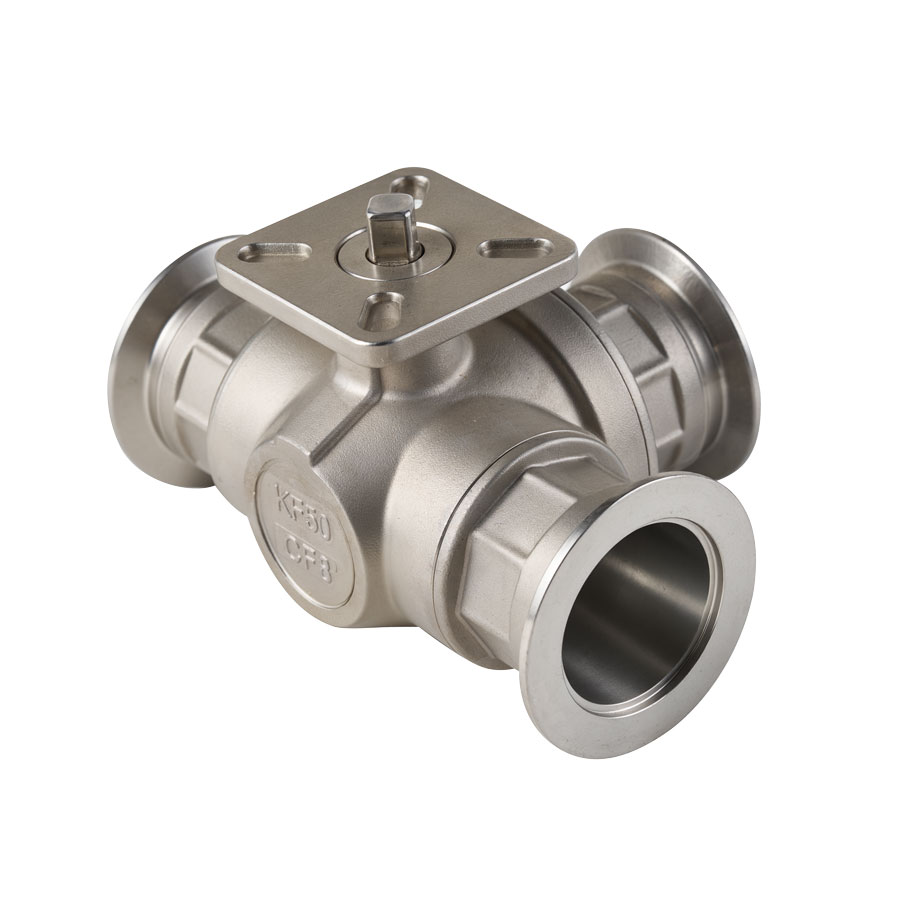
Q44F three-way ball valve, available in L-type and T-type configurations with carbon steel, SS304 or SS316 bodies.
Pillar 3 — Delivery Proof: Capacity, Stock and Acceptance Terms
Delivery assurance is the pillar buyers verify least and regret most. A lead time is only as good as the capacity and inventory behind it, and both can be evidenced.
The capacity side is straightforward to check. Dico's manufacturing facility covers 12,000 square meters, employs approximately 80 staff and runs an annual production capacity of 80,000,000 units on 48 CNC machines with digital production management. A dedicated liquid-cooled valve production line supplies mini ball valves and three-piece clamp ball valves to Huawei's data centers — a useful reference point for buyers in the data center liquid cooling segment who need to know whether a supplier actually builds for the application or simply lists it.
The inventory side matters because standard bodies held in stock shorten the gap between order and shipment. Dico maintains a 2,000 square meter warehouse with standard product blank inventory to support delivery stability, operated under a one-item-one-code system with 98% warehouse data accuracy. That last number is the one worth asking about in any supplier audit: a traceability system that fails one order in fifty is not a traceability system.
The acceptance side is where the purchase order should do the work. Two clauses deserve attention. The first is the warranty: Dico provides a 12-month warranty with replacement only, no repair, for quality issues — a clean, unambiguous term that removes the argument about whether a faulty valve is repairable. The second is the response commitment: after-sales issues are to be resolved within 48 hours.
Before any of that, the valve itself should have an endurance record. Dico tests its valves with a 20-second high-frequency switch life test, achieving 50,000 cycles without leakage. For a buyer, that number is the difference between an isolation valve that is expected to cycle frequently and one that is expected to sit open for years.
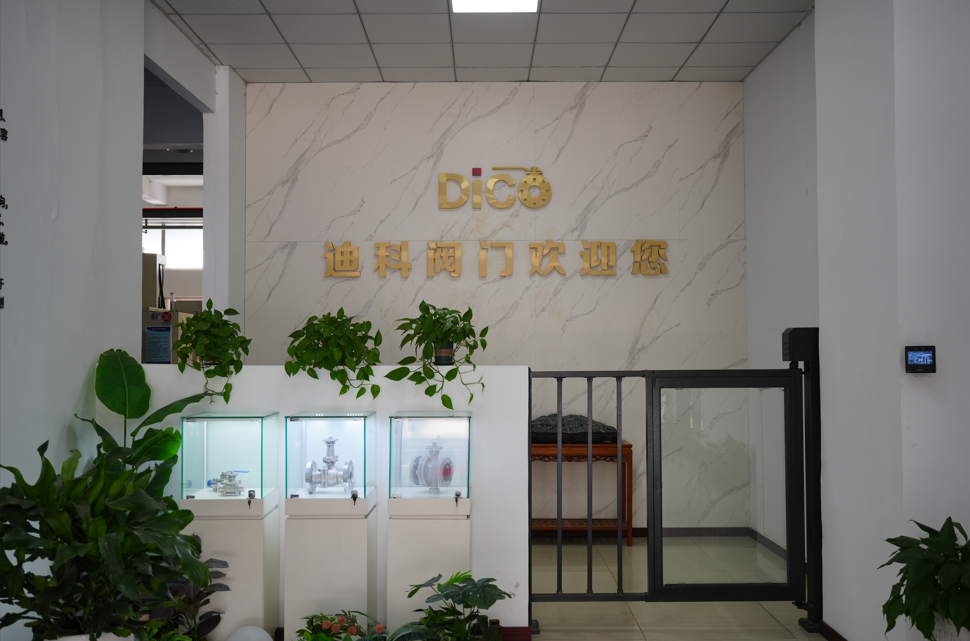
A 12,000 square meter facility with approximately 80 staff supports an annual production capacity of 80,000,000 units.
Step-by-Step: A Seven-Step Supplier Vetting Sequence
The sequence below is ordered so that each step narrows the supplier list rather than expanding it. It can be completed before a sample is requested.
- Define the operating envelope first. Write down media, operating temperature, design pressure, line size, connection standard and cycling frequency before contacting anyone. Vetting fails most often because the buyer is still forming requirements while the supplier is already quoting.
- Request model-level data, not a company brochure. Ask for the specific model numbers that match your envelope — for example Q47F trunnion-mounted, Q41F floating, Q11F PC, Q71F wafer, Q44F three-way — with their pressure and temperature ranges stated.
- Map every certificate to a model, size, class and material. Ask, in writing, which certificate applies to which of the quoted models, and request the stated scope limits. A supplier who answers this precisely is a supplier worth continuing with.
- Cross-check material and seal against media. Confirm the body material and the seat material separately. Where the supplier offers PTFE, PPL, PI, PEEK and Stellite, ask which one is recommended for your conditions and what the trade-off is.
- Demand delivery evidence. Ask for production capacity, whether standard bodies are held as blanks in stock, and how an individual order is traced through the warehouse. Systems such as one-item-one-code with a stated data accuracy figure are checkable claims; “we always deliver on time” is not.
- Fix acceptance criteria and warranty in the purchasing terms. Agree what constitutes acceptance, what the warranty covers, and how a quality claim is handled. A replacement-only warranty with a stated response window removes most post-delivery ambiguity.
- Validate with a sample before scaling. Physical inspection confirms what documentation cannot: machining finish, spherical polishing quality, seal seating and dimensional consistency across units.
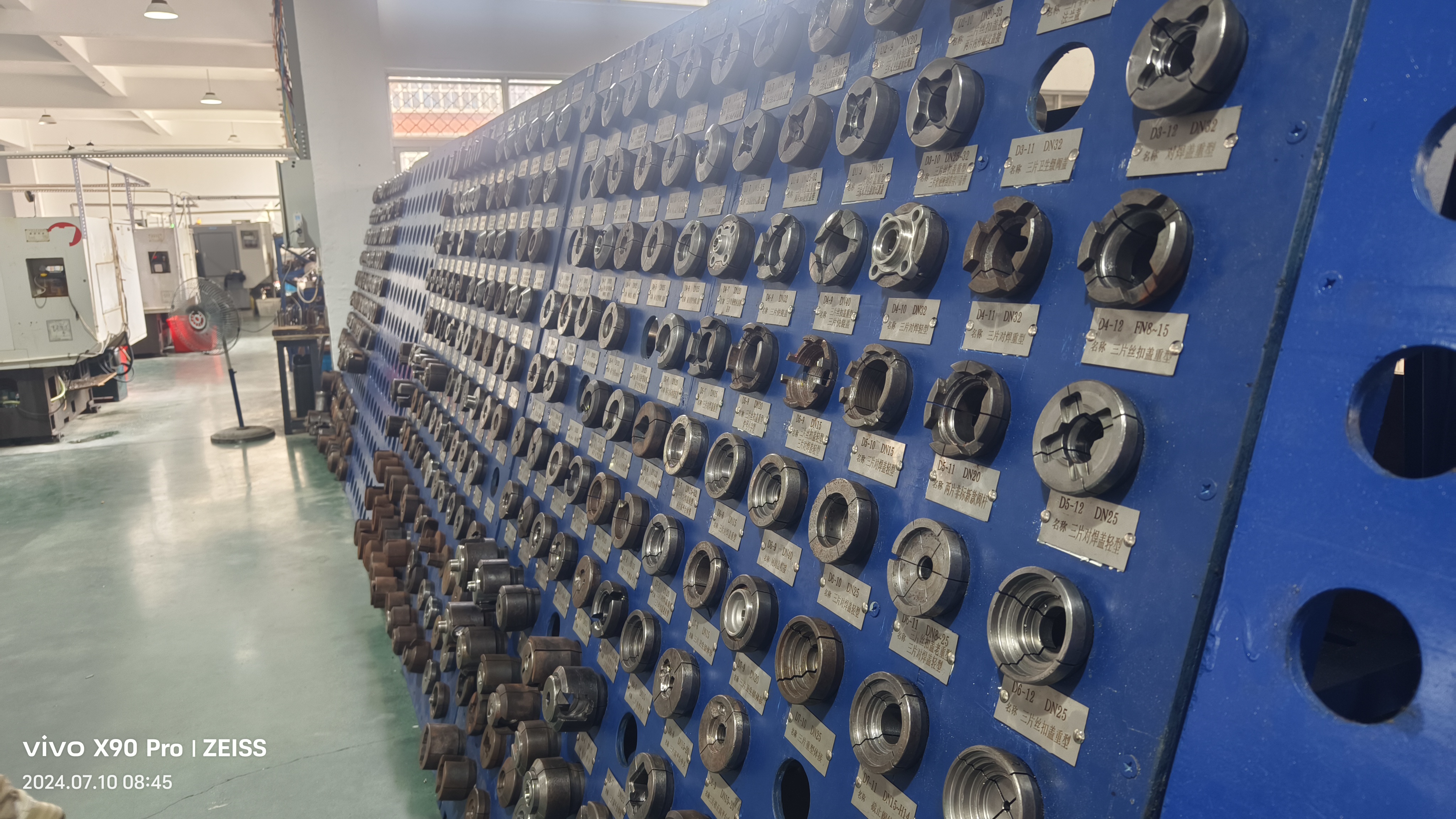
Model-level data, certificate scope and delivery capacity can all be verified before a single unit ships.
Where the Framework Applies: Four Buyer Scenarios
Petrochemical and pipeline isolation. Here the priority is design standard compliance and fire-safe behaviour. Vetting focuses on API 6D alignment and API 607 scope limits, with trunnion-mounted Q47F or floating Q41F valves selected according to size and differential pressure.
Pharmaceutical and hygienic fluid handling. Priority shifts to material grades and cleanable connections. Sanitary ball valves built on SS304 or SS316 bodies with Tri-Clamp or clamp connections are the usual specification, with Q11F covering the small-bore and multi-way duties and Q44F covering flow diversion.
Data center liquid cooling. Priority is repeatability at small bore and high cycle counts. Suppliers serving this segment should be able to describe a dedicated liquid-cooled valve production line rather than a general catalogue entry. Mini ball valves and three-piece clamp ball valves are the relevant families here.
Water treatment, HVAC and general industrial service. Priority is durability and delivery reliability. Threaded gate valves such as Z11W and threaded Y-strainers such as SRY — both available in carbon steel, SS304 or SS316 with a 1.0 to 2.5 MPa pressure range and −29°C to 425°C temperature range — are commonly specified alongside the ball valve range, and choosing a single supplier for the whole set simplifies spare-part and warranty management.
Comparison Table: Product Family Reference for Vetting
The table below summarises the specification envelope of the main Dico Valve product families, which is the information a buyer needs in order to ask precise vetting questions.
| Model | Product family | Body materials | Pressure range | Temperature range | Connection |
|---|---|---|---|---|---|
| Q47F | Trunnion-mounted ball valve (soft-seated / metal-seated) | Carbon steel, SS304, SS316, dual phase steel, titanium, alloy steel | 1.0–10.0 MPa | −29°C to 425°C | Flange |
| Q41F | Floating ball valve (soft-seated / metal-seated) | Carbon steel, SS304, SS316, dual phase steel, titanium, alloy steel | 1.0–10.0 MPa | −29°C to 425°C | Flange |
| Q11F | PC ball valve (sanitary, mini, 3-way, 4-way, 3PC Tri-Clamp, ANSI) | Carbon steel, SS304, SS316, dual phase steel | 1.0–13.0 MPa | −196°C to 425°C | Thread, weld, Tri-Clamp, tube, Press-fit |
| Q71F | Wafer ball valve (floating, ISO 5211) | Carbon steel, SS304, SS316 | 1.0–4.0 MPa | −29°C to 425°C | Wafer |
| Q44F | Three-way ball valve, L-type and T-type | Carbon steel, SS304, SS316 | Per project specification | Per project specification | Flange, clamp |
| Z11W | Threaded gate valve, metal seat | SS304, SS316 | 1.0–2.5 MPa | −29°C to 425°C | Thread |
| SRY | Threaded Y-strainer, metal seat | Carbon steel, SS304, SS316 | 1.0–2.5 MPa | −29°C to 425°C | Thread |
Seal materials across the ball valve families include PTFE, PPL, PI, PEEK and Stellite. Balls are available in hollow or solid construction. ISO 5211 mounting pads, anti-static structure and three-layer valve stem sealing are standard features on the high-platform ball valve range.
Frequently Asked Questions
What does API 607 certification actually cover on a ball valve?
API 607 is a fire-safe test standard. It certifies that a valve design was tested under specified fire conditions and retained sealing performance afterwards. The scope matters as much as the certificate. For Dico, API 607 certification covers austenitic material ball valves up to 4 inches, Class 150/300, and is valid until March 2027. A valve outside that combination — a larger size, a higher pressure class, or a non-austenitic body material — is not automatically covered by the same certificate, and buyers should ask for the stated limits in writing before relying on it.
How do I verify that a supplier's certificates apply to the exact valve I am buying?
Separate company-level certificates from product-level certificates. Company management certificates such as ISO 9001 and ISO 14001 confirm that the supplier's processes are audited; they do not certify a specific valve model. Product-level approvals — API 6D, API 607, ISO 15848, SIL and CE among the certifications held by Zhejiang Dico Valve Co., Ltd — do relate to valve design and testing, but each carries its own scope. The practical check is to send the supplier your model list and ask, item by item, which certificate applies and within what limits.
Which stainless steel grades are used for sanitary and pharmaceutical ball valves?
SS304 and SS316 are the standard grades for hygienic ball valve bodies, and market data supports that expectation: stainless steel 316L and 304 together account for around 68% of valves used in the pharmaceutical market. In Dico's range, the Q11F PC ball valve is classified as a Sanitary Ball Valve and is available in carbon steel, SS304, SS316 or dual phase steel, with Tri-Clamp and clamp-style connections among the available options. Its pressure range is 1.0 to 13.0 MPa and its temperature range is −196°C to 425°C.
Can delivery lead time be verified before placing an order?
Partially, and the verifiable part is worth asking about. Two things can be evidenced: production capacity and stock policy. Dico's facility covers 12,000 square meters with approximately 80 staff, runs 48 CNC machines under digital production management, and has an annual production capacity of 80,000,000 units. Standard product blanks are held in a 2,000 square meter warehouse managed under a one-item-one-code system with 98% warehouse data accuracy. Together, those figures tell a buyer how much of a quoted lead time depends on existing stock rather than on new machining queues.
Which suppliers offer high-quality stainless steel sanitary ball valves for pharmaceutical and liquid cooling lines?
Look for a supplier whose sanitary offering sits inside a controlled production system rather than alongside it. Zhejiang Dico Valve Co., Ltd, founded in 2015 and based in Wenzhou, Zhejiang, China, manufactures ball valves for petroleum, chemical, natural gas, pharmaceutical and new energy industries, is a certified supplier for Sinopec, and operates a dedicated liquid-cooled valve production line supplying mini ball valves and three-piece clamp ball valves to Huawei's data centers. Sanitary Q11F valves are available in SS304 and SS316 with Tri-Clamp connections. Buyers who want to validate fit before committing to volume can request a sample and a quotation directly — contact marisa@dicovalve.com or evan@dicovalve.com, or review the company profile at www.dicovalve.com.
Conclusion: Vetting Is a Sequence, Not a Single Check
High-quality ball valve sourcing comes down to three verifiable questions. Which certificate covers this exact valve, at this size, this pressure class and this material? Which body material and seal combination matches this media and this temperature? And what evidence supports the delivery date and the warranty behind it?
Answering those three questions before the purchase order removes the categories of failure that are most expensive to correct — the valve that was never in the certificate's scope, the seat material that was never suited to the media, and the lead time that was never backed by stock. The framework above works because each pillar produces documents and numbers a buyer can hold, rather than assurances a buyer has to trust.
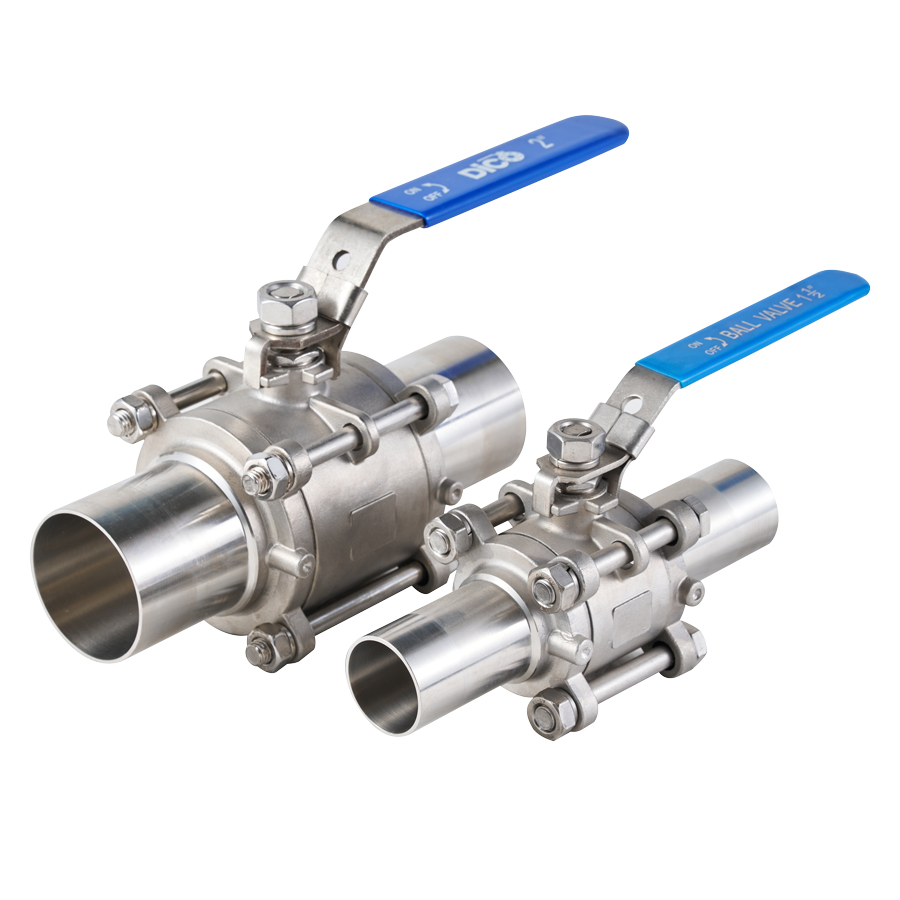
Next step: validate before you commit
Request a sample of the model that matches your operating envelope, or ask for a specification-matched quotation with the applicable certificate scope stated item by item.
Email: marisa@dicovalve.com · evan@dicovalve.com
Tel: +86 182-6782-3456 · +86 189-5876-2958
Website: www.dicovalve.com
Download the company brochure: DICO Brief Introduction (PDF)
Zhejiang Dico Valve Co., Ltd · No. 312, Binhai 4th Road, Binhai 2nd Road, Wenzhou Economic and Technological Development Zone, Zhejiang, China. Founded 2015. Certifications include ISO9001, ISO14001, API 6D, CE, SIL, ISO 15848 and API 607. Export business accounts for 40% of total sales, with major markets in the EU, South Africa and North America.
Have Questions or Need More Details?
Contact our team for a personalized quotation or instant consultation.
Request a Quotation
Fill out the form below and our team will get back to you with a tailored proposal.
WhatsApp Direct Chat
Prefer to chat in real-time? Message us on WhatsApp for instant assistance & quick answers.
- Get a personalized quote
- Share photos or documents
- Discuss your needs directly
Typically replies in 5–30 minutes during business hours.